Living Inside the Machine
Review of Pascal Chabot's book, Our Lives in a Capsule
Belgian philosopher, Pascal Chabot, is known to English readers only through two translations of early works, published by Bloomsbury: The Philosophy of Simondon (2013) and Global Burnout (2018). These works contain the germs of the main motifs that Chabot later develops in more than a dozen books published by Presses universitaires de France (PUF): the relations between humans and machines; individuality and technological evolution; the exhaustion of humanism and perfectionism resulting from progress, and the relentless drive toward efficiency and optimization. The three most recent books, Avoir le temps (2021), Un sens à la vie (2024), and Nos vies encapsulées (2026), the last of which, just published and reviewed here, build these ideas into a firm lookout point (I hesitate to call it a system because system is foreign to Chabot’s flexible method), from which to observe material and technical progress, and the widening gap between our tangible and intangible comforts.
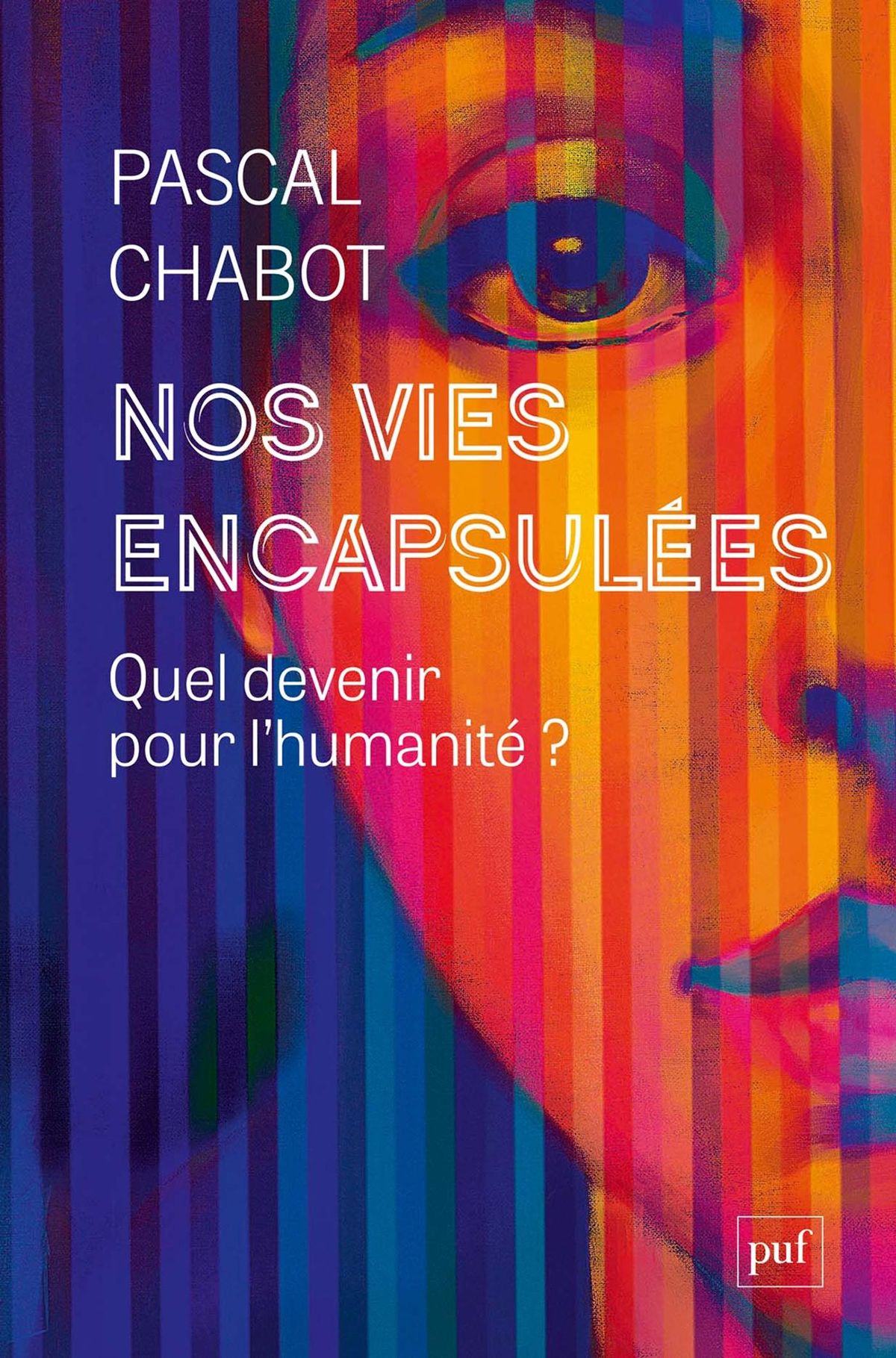
Presses Universitaires de France, 2026
240 pp. · €19
Order the book →
The progression of Chabot’s books can be read as an ethical chronicle of the advances of technology, of how they interact with classical philosophical categories (time, place, quality, change, relation, etc.), and how they are intertwined with the human condition (experience, work, loss of meaning, burnout, order, and chaos) and with the large cultural narratives (myths, religions, epochs, civilizations). Nor does Chabot neglect the pathologies of hyperconnectivity, the “digitoses” under which he assembles the particular anxieties, neuroses, and psychoses of the digital existence. Holding all the threads together is Chabot’s compelling language, with its inventions, puns, and polysemy, and frequent references to the poets. And no matter how technical the discussion becomes (“philosophy starts where the obvious ends,” says Chabot), beauty is never overlooked, and a path is always open for a return to Tipasa.
Chabot teaches at the Institute for Higher Social Communication Studies in Brussels. His work embraces collaborations in arts as diverse as choreography, photography, film, and theater; since 2023 he has been the curator of the Tournai festival of philosophy and music.
In English, when we describe an isolated existence or someone sheltered from the harsh realities that others face, we speak of “living in a bubble.” There is a word for bubble in French, bulle, but Pascal Chabot chose a hardened bubble to describe our habitat, one that is not easily pierced and does not burst spontaneously: a capsule.
From reading the old masters, Pascal Chabot has learned two things that many present-day philosophers have forgotten: that philosophy is the most practical of disciplines and that the language best suited for its discovery is poetry. What medium is more fitting than poetry for probing the depths of time, the meaning of life, and the condition of our existence? “Poets are often at the vanguard of philosophy,” Chabot writes in his most recent book, Our Lives in a Capsule.1
Chabot has been on a technology watch all his career. Since his PhD dissertation on Simondon, whom he calls “the foundational figure of the philosophy of technology,” he has been examining from various angles the presence of machines in our lives and the many aspects of our relationship with them.2
In the dead center of Our Lives in a Capsule, at the seamline between Parts I and II, Chabot makes his method explicit, when he tells us that Plato “knew what to expect from philosophy: clarity, light, exercising the power of reason, understanding the chasm between appearances (the shadows on the walls) and essences, denouncing the power that makes prisoners persist in an illusion, and finally the possibility of a liberation of the soul, destined for immortality.” This is a gracious portrait by a contemporary philosopher of a colleague who, twenty-five hundred years earlier, was engaged in the same enterprise of binding the universe of ideas tightly to our everyday experience, and a belated acknowledgement of apprenticeship.
In his books, Chabot identifies and names direct and indirect consequences of technological progress: the recent “ultraforces,” megaplayers that control our physical reality; the “superconscious,” the digital store to which we are permanently connected, and “digitose,” one of its consequences; the “autology” and “technonomy,” perversions of the Enlightenment ideals of autonomy and technology; “hubject,” one of the present-day mutations of the subject, and many more.3 He carefully traces the biographies of these concepts, some of which go back many hundreds of years, and predicts their future course. In 2016, in what appears in retrospect as a preamble to the present book, he imagined a modern Platonic dialog set a decade into the future, which is more or less now, between a nearly eponymous “Chatbot” trained in philosophy and Barnabooth, a skeptical human practitioner of the art.4 Today, Claude, Gemini, or GPT would readily agree to play the part of the Chatbot in this dialog as they discuss intelligence, selfhood, consciousness, superiority, mortality, and power. The dialog asks what happens when intelligence becomes machinic, and Barnabooth wavers between rejecting the robot as a genuine philosopher because “to study philosophy is to learn how to die,” and accepting it when it turns out to be capable of doubt. In its ambiguous ending, the dialog anticipates our concerns by a decade: intelligence vs. wisdom, imitation vs. understanding, the alliance of AI with commercial interests, and humans enacting machinoids as they adapt themselves to machine logic.
The present book serves as the capstone of a trilogy that also includes About Time (2021), in which Chabot spells out the temporal experience in the age of accelerating technological advance, and A Meaning for Life (2024),5 where he develops the notion of the cloud as a “superconscious,” a communal store of wisdom and awareness to which we are tethered for keeps. All along, Chabot seeks to reconcile the upheaval caused by the digital intrusion in our lives with the human psychology that took millennia to reach the point where it met the Internet. The first two books, however, did not take into account the emergent technology of GenAI, which has come to redefine what it means to be human, to think, create, and relate to our surroundings. This task was left to Our Lives in a Capsule. This is not a trilogy of technology but of the human condition. Each book studies a different dimension of dwelling. The first asks about temporal habitation: How do we inhabit time? The second about existential habitation: How do we inhabit meaning? The third about spatial-technological habitation: How do we inhabit the technological worlds we have built? All three reflect a persistent attempt to reconnect technological analysis with questions of human flourishing.
The capsule as parable
The capsule is a powerful metaphor because it is both protective and isolating. It “expresses the full ambiguity of contemporary existence.” For untold generations we have built places of refuge where we could withdraw or travel in safety, protected from natural and human intruders. These havens served as places of temporary rest and repair, from which humans emerged to ply their trade and gather supplies, produce and consume, work and play. They were not meant to isolate and insulate, but with advances in engineering, they became increasingly protective. As control of access improved, they acquired qualities resembling sealed-off spaces used to explore the depths of seas and outer space, in other words, capsules. With optimization (let us remember that word), the capsules became fit for work. When social media and entertainment were admitted, the incentive to leave the capsule was further reduced. But there remained one element that could not be injected into the capsule without allowing in another human: intelligent interaction in real time. Then came GPT.
Chabot catalogs the many types of capsules, static and mobile, physical and mental, nested within others like Russian dolls, each one “a protective milieu that offers an interiority shielded from the outside.” The optimized capsule becomes our habitat: Nous habitons désormais dans la machine (“From now on, we dwell inside the machine”). In an autoclave, to be exact. Chabot notes the transformation that has taken place in our use of tools, which changed from prostheses, aimed to increase our strength and extend our reach (a centrifugal, outward-directed technology), to autoclaves (used etymologically, as self-sealing spaces), that act centripetally, turning inward. If prosthetic technology is about exteriorization, autoclave technology is about encapsulation. “The era is centripetal, the age isolationist.” The shift from loudspeakers to earbuds serves as a good illustration. The technological achievement is the same, sound reproduction, but the social geometry is reversed: one is a prosthesis projecting sound outward to be shared by a crowd; the other an autoclave designed to immerse one individual in a private world of sound.

A special category is the time capsule, an object at the same time literal and metaphorical, facing outward toward the future. It provides a perceived service to subsequent generations, but it is more accurate to view it as an attempt at guiding our descendants in forming their image of ourselves. The Westinghouse time capsule, buried at Flushing Meadows Park in 1939, is confidently scheduled to be opened in the year 6939. Later capsules contain material intended for other ages as well as for other intelligences. The Voyager probe, launched into space in 1977, offers Sounds of Earth on a golden record. One cannot help smiling at the romantic vision of the capsule curators, imagining their delight at picturing a resident of a moon at another corner of the galaxy, some forty thousand years from now, following the pictorial instructions on the record player and suddenly being struck by the sounds of the Prelude in C major of Bach’s Well Tempered Clavier, played by Gould. “Ah, yes, superb voice leading,” the extraterrestrial will exclaim, “but it could use a bit more pedal.”
The concept of the capsule is doing here more work than time did in About Time and meaning in A Meaning for Life. It is at the same time spatial, technological, phenomenological, political, and finally, moral. The capsule is an ambiguous entity, however, and should not be confused with a prison cell. It is a shelter that can become a prison, but a prison enfolded in the meta-capsule of the superconscious, infinitely nourishing yet never satisfying, with which it is permanently linked.

Pascal Chabot
The usefulness of the subtle
It was the relentless thrust for optimization that has driven us into the capsule, where everything is snug, on hand, available, predictable, in other words, useful. What will drive us out of the capsule is the quest for the free form, the irregular, the surprising, that is to say, the subtle. In French, the useful and the subtle, utile and subtile, make a neat, rhyming pair. Chabot first developed the categories of the useful and the subtle in About Time and has elaborated them since. In About Time, they were merely attributes, or rather domains of progress; technical and utilitarian matters vs social and moral ones. But before anything else, Chabot’s is a moral philosophy; therefore, the useful and the subtle are apt designations of the material elements responsible for making our daily lives increasingly comfortable, and the intangible ones entrusted with our immaterial comforts, such as social cohesion, intellectual nourishment, and artistic fountainhead. In Capsule, they have become philosophical principles associated with optimization and justness: the useful tending toward optimization, the subtle toward justness (justesse). Chabot is juggling here two terms, justice and justesse, derived from the same root. Justice is the same as the English “justice,” but justesse has strong connotations of that which is right, appropriate, even fair, the English word that captures a convergence of the right and the beautiful, where other languages must resort to paraphrase. In French, both questions, “Is it just?” and “Is it fair?” are rendered using the same word: “Est-ce juste?” Thus, whereas the telos of the useful is clearly optimization, that of the subtle is a mixture of rightness, beauty, culture, meaning, trust, dignity, wisdom, and yes, fairness, the word that shows how, at the highest point, the ethical and the esthetic are one. Philosophy “is, par excellence, the place of the subtle,” says Chabot.
The main argument of the book is that technological civilization has completed a centripetal turn — we no longer wield tools, we inhabit them — and that survival of the human against the imperial logic of optimization depends on cultivating the subtle: the irreducibly plural goods of meaning, beauty, solidarity, and soul that no autoclave can manufacture and no algorithm can supply.
The useful and the subtle are not antagonists, however. Chabot’s concern is not to diminish useful progress but to prevent it from outrunning the subtle. The useful culminates in optimization; the subtle safeguards the plurality of human goods that optimization alone cannot secure. Chabot argues that the health of the civilization depends on the two marching hand in hand.
Conned by the supercon
The first whole-body MRI scanner was produced in the early 1980s by a team spun off from the University of Aberdeen, led by Prof. John Mallard. It was built around a massive permanent iron-core magnet. As the technology spread, the chief players (GE, Siemens, etc.) developed superconducting magnets that operate at very low temperatures, close to absolute zero, cooled by elaborate and expensive-to-maintain cryogenic systems. On his desk, John Mallard had a sign that read: “Don’t be conned by supercon.” I borrow Mallard’s pun freely, and extend it to Chabot’s surconscient, which I render as the “supercon,” alluding to a different kind of trap entirely. I chose it because it captures so aptly Chabot’s thinking. John Mallard was not against superconducting technology; he warned against being dazzled by it. Mallard’s subtlety was not an expression of resistance to technology (among others, he designed also the first PET scanner) but of his simultaneous recognition of multiple dimensions of value. He was making a technical argument about the technology that would best serve human purposes, showing subtlety in operation within the technical domain itself. Similarly, Chabot is not a critic of technology but of enchantment by it, his entire project being an attempt to preserve the subtle against the imperial expansion of optimization.
What Mallard said about one supercon applies equally to the other. The danger lies not in the technology itself but in the tendency to surrender judgment to it. Since that smallest and most intimate of capsules, which contains the essence of who we are, our skull, is now firmly attached to the digital supercon, we go through life with our head in the cloud, so to speak. (Chabot recasts the eternal triad as the conscious, the subconscious, and the superconscious.) It is a tight human-machine coupling, à la Simondon, into an ensemble that functions as a milieu where humans and machines co-evolve in a continuing process of association, and machines become integrated in human civilization. “Chatbots are not a literary fad, but new brethren to whom a place will have to be made.” The culmination of the process, elaborated in A Meaning for Life, is the emergence of a digital oracle that we initially visited sporadically but that gradually settled into our daily cognitive routines, turning each individual memory into a node in a global network of knowledge, information, and opinion. This superconscious now inhabits us, and through it, bits and pieces of the outside seep into the capsule, upsetting the comfortable arrangement with disruptive content. Potentially, it also points the way to the world outside the capsule and provides the rope ladder for reaching it.
Our connection to the superconscious is not a metaphor. Chabot calls it an anthropological mutation. “Each connection that passes through us makes the idea of a subject a little more of a fiction,” as we change from an “I” filled with its own views into a hub in a circuit through which data flows without any hope of our being able to fully digest it. We have mutated into hubjects. We have become hubs, concentrators of thoughts and desires not our own. Our overwhelmed consciousness is colonized by the supercon, which ends up “dictating what it would be appropriate to think.”
The hubject self-organizes by telling its own story. Its consciousness is narrative. To live is to speak to oneself, to take oneself as an interlocutor. It is to share memories with oneself, to ruminate and to hope, to become the subject and the object of one’s own story. Thus is built an interior world, the capsule we carry within us, that bubble of consciousness that we are, which all the stories of others, from the beginning, traverse and modulate, making of our interiority a vast crossroads of stories and loves. They are so many, and sometimes so noisy, that it is surprising people don’t more often ask each other: “Doesn’t all that noise in my head bother you?”
Just as the capsule is both shelter and prison, the supercon is both wisdom and noise, colonization and enlargement. And like the capsule, it has an equivocal existence, between solipsistic self-assembly and unbroken exposure to uncurated clatter. It simultaneously threatens autonomy and enlarges experience, making the hubject one of Chabot’s most ambivalent figures. On one hand, it is empowered because it can assemble itself from innumerable influences. On the other, it is weakened because it may lose its stable center from which to evaluate those influences. Chabot deliberately leaves unsolved the question whether the hubject represents an enlargement of human experience or a new form of dependence. What kind of being emerges when subjectivity is permanently connected to the superconscious? The answer is neither triumph nor catastrophe. It is mutation. The hubject is not the victim of a mutation. It is the mutation, and Chabot entertains the possibility that disconnection is one of the new names for freedom.
Mutatis mutandis
Everything that can mutate mutates: first and foremost humans (the anthropological mutation), but also the fauna and flora, capsules, cities, societies, laws, progress and becoming, consciousness, common sense… even the void. Among the most consequential are mutations Chabot doesn’t explicitly name but illustrates abundantly: linguistic ones. He identifies the ideals of the Enlightenment to be embodied in the autonomy — technology pair. This ideal undergoes a perverse mutation in our day into technonomy (technology imposing its own law) and autology (uncurated discourse about oneself in the echo chambers of the supercon), both diametrically opposed to the visions of Voltaire and Diderot. But then, in a headspinning new mutation, the pair is rehabilitated in the form of nomology and autotechnics. Chabot does not simply describe mutations; he performs them as they unfold in the text. Each is precisely defined, elaborated, and amply illustrated, in a veritable semantic fugue of transformation. Mutation is both the theme and the procedure of the book. Because reality is mutable, language adequate to reality must also be capable of mutation.
The argument by paronomasia
Puns, not always readily translatable into English, are often the carriers of more than what they are intended to bear. Although autology and technonomy, hubjects and ultraforces, superconscious and digitoses are not intended to be demonstrative but rather heuristic, Chabot uses them to open a conceptual space where philosophical work can begin. It is an edifying move, often dazzling. Similarly, the etymological proof is always on hand in Chabot’s toolkit, to illuminate the deeper meaning of a term like inform or babble, which we may be using blithely, without paying sufficient attention to its many connotations.
Chabot thinks through writing, creating the impression that the sentence is not merely expressing the thought but helping discover it. This quality, which is neither strictly literary nor strictly philosophical but resides somewhere at the intersection of the two, is one of the distinctions that makes Chabot’s books memorable. His philosophical method is inseparable from the style of his prose, where concepts are often generated through metaphorical and linguistic exploration rather than formal deduction. The linguistic inventiveness that produces ideas like “élan artificiel,” turning Bergson’s élan vital on its head, is very close to that which produces pairings such as justesse/justice, where one wonders whether the language is carrying the argument a little farther than the concepts alone can support. The elegance of the language often feels like enactment, the linguistic transformation performing the conceptual transformation it is supposed to demonstrate.
Moral values
Chabot is first and foremost a moral philosopher. He is interested in technology because it determines the degree of our free will, shapes time, attention, meaning, work, and relationships, and transforms the human condition. The question Chabot asks again and again in different forms concerns the kind of life humans should lead under contemporary technological conditions and the responsibility they bear to future generations — in short, how we should live.
Whether he talks about Leibniz or Simondon, Descartes or Bergson, time or the meaning of life, or as in this case, the encapsulation of our bodies and minds, Chabot’s intention is always the same: to reconnect his readers with themselves. His preoccupation is always principled, as he painstakingly explains to his readers the meaning of their most common and seemingly thoughtless gestures, fitting them into the evolutionary sequence by which they have come to be what they are, in a long chain of emergence. But making sense of a shifting reality in real time is becoming increasingly difficult under conditions of exponential technological change, when by the time we put a period at the end of a sentence, what we wrote at the beginning of it may no longer be true.
The view from Brussels
Chabot’s incisive analysis can lead to idealistic conclusions about the possible futures to which our present encapsulation might lead. For example, when talking about his students, he makes one envy the staff of the institute in Brussels, where he teaches. In the utopian college auditorium he describes, 450 unspoiled, eager, and receptive young minds together step out of the capsules to imbibe the lessons of philosophy and connect in a spontaneous network of emotional, social, and activist nodes, where “random chance produces better social relations than the predefined filters of algorithms.” This vision, alas, is checked by a reality documented in countless accounts and images of other lecturers facing hundreds of upturned identical laptop lids with glowing Apple logos, behind which students scroll through social media feeds, watch videos, play games, and shop — in the middle of the 450-seat auditorium.
In the final pages, there is a shift in register into explicit political language that sits uneasily with the rest of the book. The idealized Europe that has forever renounced cruelty, which Chabot conjures up toward the end of the book, works better at the literary than the public level. Chabot drops here his most eye-popping pun about transforming Europe’s old ways, its “ancient alleyways” (antiques ruelles) into a call for becoming “anti-cruel” (anti-cruels) — rendered in one’s earbuds as almost perfect homonyms but processed quite differently by neurons in most brains. Still, we should be careful before dismissing Chabot’s political optimism, which may arise from the same source as his moral philosophy. He is not a philosopher of conflict but of coexistence. The Europe that emerges from Chabot’s recent writings is a moral project more than it is a geopolitical actor.
Optimizing optimism
Chabot never presents his ideas as a rigid system. In different chapters, the same ideas emerge from different examples under different names. Yet they seem to gravitate toward the same polarity, one theme appearing under several disguises: useful/subtle, optimization/justness, inward/outward, centrifugal/centripetal, subject/hubject, conscious/superconscious. They are all held together by mutations. The capsule itself is a mutation. Autonomy mutates into autology. Technology mutates into technonomy. Useful progress mutates into optimization. Human consciousness into supercon. Even philosophy mutates into practice that must operate under the conditions created by digital civilization. But Chabot never advocates return or restoration. His answer is almost always another mutation. Autology becomes autotechnics. Technonomy becomes nomology. The linguistic mutation ends up being more than merely wordplay. The movement is evolutionary — a Simondonian structure.
This is why Chabot’s optimism, including the final political pages, is so difficult to evaluate. His optimism lies deeper than his political analysis, in his conviction that yet another mutation, beyond optimization, is always possible. And language is always the mechanism by which Chabot enacts the mutations he describes. The conceptual transformations are almost always accompanied by linguistic ones. A new word appears. An old word is recast. A latent relation between words is uncovered. A familiar term acquires a new trajectory. Language is not merely conveying the philosophy; it is where the philosophy is happening. What appears to be wordplay is part of the engine that drives Chabot’s central argument that technological civilization can still generate forms of human becoming that are richer than the logic of optimization. For those who can briefly disconnect from the supercon for some autonomous thinking, Chabot opens a porthole showing the path we followed to our capsules but also one leading to the next mutation, and arguably, to disconnection and freedom.
Gabriel Lanyi on Daily Philosophy:
References
- Chabot, P. (2003). La philosophie de Simondon. Vrin.
- Chabot, P. (2008). Après le progrès. Presses Universitaires de France.
- Chabot, P. (2013). Global burn-out. Presses Universitaires de France.
- Chabot, P. (2013). The Philosophy of Simondon: Between Technology and Individuation. Bloomsbury.
- Chabot, P. (2015). L’âge des transitions. Presses Universitaires de France.
- Chabot, P. (2016). ChatBot le robot: Drame philosophique en quatre questions et cinq actes. Presses Universitaires de France.
- Chabot, P. (2017). Exister, résister: Ce qui dépend de nous. Presses Universitaires de France.
- Chabot, P. (2018). Global Burnout. Bloomsbury.
- Chabot, P. (2021). Avoir le temps: Essai de chronosophie. Presses Universitaires de France.
- Chabot, P. (2022). Six jours dans la vie d’Aldous Huxley. Presses Universitaires de France.
- Chabot, P. (2024). Un sens à la vie: Enquête philosophique sur l’essentiel. Presses Universitaires de France.
- Chabot, P. (2026). Nos vies encapsulées. Presses Universitaires de France.
- Lagarde, F. (Director), & Chabot, P. (Co-creator/Narrator). (2012). Simondon du désert. Documentary film. Hors-Œil Éditions.
- Larbaud, V. (1903). Journal intime de A. O. Barnabooth. Éditions de la Nouvelle Revue Française.
Notes
-
Nos vies encapsulées, Presses Universitaires de France (PUF), 2026. All Chabot books cited have been published by PUF. Unless otherwise noted, quotations are from Our Lives in a Capsule. Translations from French, including of book titles, are mine. ↩︎
-
La philosophie de Simondon (2003), about Simondon, the proponent of a general phenomenology of machines and their dynamic, processual reality. In the intervening decades, PUF published more than a dozen of his books, some of which have been translated into English, German, Spanish, and Italian. Chabot was also the narrator, interviewer, and explicator in a poetic documentary about Simondon by the late cinematographer, Francois Lagarde: Simondon du désert, Hors oeil éditions, 2012. It is difficult not to attempt to find in Lagarde’s choice of the title an echo of Buñuel’s 1965 film, Simon of the Desert, about the 5th c. ascetic who renounced life in this world in favor of a higher calling. Simondon also stood apart in his lifetime, in the margins of dominant philosophical trends, until rediscovered after his death by Deleuze and others. ↩︎
-
Après le progrès (2008); L’âge des transitions (2015); Global burn-out (2017; Avoir le temps (2021); Exister, résister (2023); Un sens à la vie (2024). ↩︎
-
ChatBot le robot (2016). The name Barnabooth is almost certainly a hat tip to Valery Larbaud’s Intimate Journal of A.O. Barnabooth (1903), about a similarly cultivated, detached skeptic who travels between cultures and identities, both insider and outsider, and like Chabot himself, a literary rather than purely academic philosopher. ↩︎
-
Un sens à la vie (2024). The French word sens means both “meaning” and “direction.” No single English word captures both dimensions. Chabot’s philosophy often unfolds in semantic spaces available in French but not easily reproduced in English. ↩︎