Love in Buddhism
Mettā, karuṇā and bodhicitta: how a tradition that warns against attachment made boundless love the heart of its ethics
One day in Sāvatthī, a wealthy woman named Visākhā came to see the Buddha at midday, her hair and clothes still wet from the funeral of her granddaughter. Visākhā was the greatest of the Buddha’s lay patrons, a mother of many children and grandmother of many more, and she had loved the dead girl dearly. The Buddha asked her whether she would like to have as many children and grandchildren as there were people in the city. She said she would. He asked how many people died in Sāvatthī each day. Some days ten, she said, some days one; the city was never free of the dying. “Then would you ever be without wet hair and wet clothes?” No, she admitted. And the Buddha said:

The story is in the Udāna (8.8), one of the oldest collections in the Pali canon, and it is the kind of passage that makes people say Buddhism is against love. Read on its own, it seems to be: love brings grief, grief is suffering, and the whole point of the path is the end of suffering. But the same canon contains the Mettā Sutta, in which the Buddha tells his monks to cherish every living thing as a mother cherishes her only child, and to let boundless love fill the whole world “above, below and across.” And the tradition that grew from that canon produced the bodhisattva, a figure who vows to remain in the world of birth and death, for as long as space endures, until every being is free – the most extravagant ideal of love in the history of religion.
How can both be true? The answer is that Buddhism drew a line through the middle of what other traditions call love, and put one half on the side of the problem and the other on the side of the cure. This entry is about that line: where it runs, why it was drawn there, and what the different Buddhist schools built on either side of it.
Pali terms are used for the early tradition and Sanskrit for the Mahāyāna; words that have entered English (Buddha, nirvana, karma, sutra, bodhisattva, Zen) are left in their usual forms.
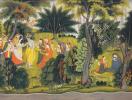
Hinduism has no single word for love – it has a dozen. This guide explains the main ones, surveys how the Vedas, Upaniṣads, Advaita and the Gītā treat love, and then focuses on bhakti, the devotional tradition that made love of God the heart of religious life. Part of our series on love in the world religions.
The words
Buddhism has no single word for love, and the absence is deliberate. Its vocabulary separates the wishing-well from the wanting.
Mettā (Sanskrit maitrī) is the tradition’s central word. It comes from mitta, “friend,” and means friendliness, goodwill, loving-kindness: the wish that another be happy. Mettā has no object it cannot take – friend, stranger, enemy, animal, oneself – and no exclusivity; it is defined by being boundless. English translators have used “loving-kindness,” “universal love,” “friendliness” and “goodwill,” and the range shows the difficulty: the word is warmer than benevolence and cooler than passion.
Karuṇā is compassion: the wish that another be free from suffering. If mettā is the sun that shines on everyone, karuṇā is what mettā becomes when it meets pain. In the Mahāyāna, mahākaruṇā, “great compassion,” becomes the defining quality of a Buddha.
Muditā is sympathetic or appreciative joy: gladness at another’s happiness, the opposite of envy. Upekkhā is equanimity: the even-mindedness that lets love extend to all without being knocked over by any. Together with mettā and karuṇā these form the four brahmavihāras, “divine abodes,” also called the appamaññā, the “immeasurables.”
Pema (Sanskrit preman) is affection, the love of the dear. The Dhammapada says grief and fear are born from it. Piya is what is dear; sineha (Sanskrit sneha), literally “stickiness” or “oil,” is clinging affection; rāga is passion; kāma is sensual desire. And taṇhā (Sanskrit tṛṣṇā), “thirst,” is craving in general – the second Noble Truth, the cause of suffering. These are the words on the far side of the line. What they share is grasping: they are forms of wanting for oneself.
Anukampā, “trembling along with,” is sympathy in the etymological sense – the word the texts use for the Buddha’s own motive in teaching. Bodhicitta, “the awakening mind,” is the Mahāyāna’s name for the resolve to become a Buddha for the sake of all beings; it is what the bodhisattva’s love is called. And dāna, giving, is love’s first practical form.
The shape of this vocabulary is the opposite of the Arabic one described in the previous entry. Where Islam had to pull the words for passion, scripture and mercy together, Buddhism held them carefully apart. The tradition’s whole theory of love depends on being able to say that mettā and pema are not the same thing.

The Qur’an says that God loves and is loved, and Muslims have argued for fourteen centuries about what that means. This guide explains the key Arabic words, sets out the three main theories – the theologians' love as obedience, the philosophers' love as cosmic attraction, and the Sufis' love as the secret of creation – and shows how the mystical tradition turned even Layla and Majnun into a parable of the soul. Part of our series on love in the world religions.
Love in the early discourses
The Pali suttas, the oldest layer of Buddhist scripture, speak of love in three registers.
First, as the Buddha’s own motive. The story of his enlightenment says that, having awakened, he doubted whether anyone could understand what he had seen, and considered staying silent. The god Brahmā Sahampati begged him to teach, and he surveyed the world “with the eye of a Buddha” and saw beings like lotuses at different heights in a pond – some ready to bloom. “Out of compassion for beings,” the text says, he agreed. When he sent out his first sixty disciples, it was “for the welfare and happiness of the many, out of compassion for the world.” The Lotus Sutra would later have him say, “I am the father of this world”; the early texts prefer the image of the physician. But in both, the Buddha’s relation to beings is a form of love, and the tradition never doubted it.
Second, as a meditation. The Mettā Sutta (Sutta Nipāta 1.8, also Khuddakapāṭha 9) is ten verses long, is chanted daily in Theravāda monasteries, and is probably the most widely known Buddhist text after the Heart Sutra. According to the commentary, the Buddha taught it to monks who had been frightened out of a forest by hostile tree spirits: they were to go back and radiate goodwill instead of fear. Its central verses run, in a fairly literal rendering:
Other suttas fill this out. The Kakacūpama Sutta (Majjhima Nikāya 21) tells the monks that even if bandits were sawing them limb from limb, one who gave rise to hatred would not be following the teaching; they should abide instead with a mind of loving-kindness towards their attackers. The Mettānisaṁsa Sutta (Aṅguttara Nikāya 11.15) lists eleven benefits of mettā: one sleeps well, wakes well, has no bad dreams, is dear to humans and non-humans, is protected by the gods, is unharmed by fire, poison and weapons, concentrates easily, has a serene face, dies unconfused, and is reborn, if not yet liberated, in the world of Brahmā. The Itivuttaka (27) says that of all the grounds for making merit, none is worth a sixteenth part of the liberation of mind by loving-kindness, which outshines them as the moon outshines the stars. And the Tevijja Sutta (Dīgha Nikāya 13) has the Buddha tell two young brahmins that the true path to union with Brahmā, which their teachers had never walked, is to pervade the world with love, compassion, joy and equanimity. This is where the name “divine abodes” comes from: the Buddha borrowed the brahmins' highest goal and redescribed it as a state of the loving heart.
Third, as a warning. The Piyajātika Sutta (Majjhima Nikāya 87) is the counterpart to Visākhā’s story. A householder whose only son has died wanders the streets asking “Where are you, my only child?” The Buddha tells him that sorrow, lamentation, pain, grief and despair are “born from what is dear.” The man is outraged – surely joy and gladness are born from what is dear! – and goes off to tell some gamblers, who agree with him. The story reaches King Pasenadi, who also thinks the Buddha has said something absurd, and quarrels with his queen Mallikā when she takes the Buddha’s side. Mallikā’s reply is one of the great moments of the canon. “Is Princess Vajirī dear to you?” she asks. Yes. “If she were to change or be lost, would sorrow arise in you?” It would. “That is what the Blessed One meant.” The Dhammapada makes the same point in verse (212–216): from what is dear comes grief, from what is dear comes fear; for one freed from what is dear there is no grief – whence fear?
The tension between the second register and the third is the whole subject. Notice, though, how the Buddha addresses it in another conversation with Mallikā (Saṁyutta Nikāya 3.8). She and the king have each admitted that there is no one dearer to them than themselves. The Buddha does not scold them. He draws the ethical conclusion: since every being holds itself dear in the same way, “one who loves himself should not harm another.” Self-love, in this text, is not the enemy of love for others. It is the starting point for understanding them.
Three forms of the theory
Out of this material the Buddhist traditions built three broad accounts of love, which are not so much rival theories as successive enlargements.
The Theravāda: love as a divine abode
The Theravāda tradition of Sri Lanka and Southeast Asia, which preserves the Pali canon, systematised love as a meditation in Buddhaghosa’s Visuddhimagga (fifth century CE), the tradition’s great manual. Chapter IX is devoted to the brahmavihāras, and its method has shaped Buddhist practice ever since.
Begin, Buddhaghosa says, with yourself: “May I be happy and free from suffering.” Not because self-love is the goal but because one cannot wish for others what one cannot wish for oneself, and because the recognition that oneself is dear to oneself is the ground on which sympathy for others is built. Then a respected teacher or dear friend; then a neutral person; then someone hostile. He warns against starting with a person one is attracted to (mettā will slide into lust), with a dead person (it will not take hold), or with an enemy (resentment will arise). If anger surfaces towards the hostile person, he offers remedies: reflect on the Buddha’s patience, or on the fact that the enemy has certainly been one’s mother in some former life, or analyse the enemy into elements and ask which of them one is angry with. The goal is sīmāsambheda, “the breaking down of barriers”: a state in which, if bandits demanded one person from a group of oneself, a friend, a stranger and an enemy, one would feel no preference about who was taken. Only then is mettā truly boundless.
Buddhaghosa also gives each divine abode a near enemy and a far enemy. The far enemy of mettā is ill will, which is obvious; its near enemy is greed or affection (rāga), which “sees good qualities” in the beloved just as mettā does and can pass for it. The near enemy of compassion is worldly grief, which also aches at another’s pain but from a place of loss; its far enemy is cruelty. The near enemy of sympathetic joy is frivolous excitement; its far enemy is envy. The near enemy of equanimity is indifference, the dull incuriosity that looks like calm; its far enemy is attachment. This scheme is the Theravāda’s answer to the puzzle we started with. Pema, the love of the dear, is not the far enemy of mettā but the near one. It is what mettā looks like when it has quietly turned into wanting.
The Theravāda position on human love follows from this. The Buddha did not ask householders to stop loving their families. The Sigālovāda Sutta (Dīgha Nikāya 31) sets out the duties of husbands and wives, parents and children, friends, teachers and employers, and treats their mutual affection as the fabric of a good society. The Buddha praised an old couple, Nakulapitā and Nakulamātā, who told him they had never wronged each other even in thought and wished to be together in future lives; he told them that if they matched each other in faith, virtue, generosity and wisdom, they would be (Aṅguttara Nikāya 4.55). He called mother and father “Brahmā,” the highest god, to their children (Aṅguttara Nikāya 4.63). What he asked was that such love be held without grasping, and that it not stop at the family. Whether the fully awakened person, the arahant, still has particular loves was debated; the texts show the Buddha himself weeping for no one but tender to everyone, and Ānanda, his attendant, weeping openly at his death and being thanked for his years of loving service – mettena, “with mettā,” the Buddha says, in body, speech and mind.

Guanyin, the bodhisattva of compassion, in the pose of royal ease; wood, Song dynasty, twelfth century. Asian Art Museum, San Francisco.
The Mahāyāna: love as the awakening mind
The Mahāyāna, the “Great Vehicle,” which emerged in India around the beginning of the Common Era and became the Buddhism of China, Korea, Japan, Vietnam and Tibet, did not abandon the divine abodes. It changed what they were for. In the early tradition, mettā is a support for the path: it steadies the mind, generates merit and softens the heart, but liberation comes from insight. In the Mahāyāna, love becomes the path itself, and the ideal practitioner is defined by it.
That practitioner is the bodhisattva, one who has generated bodhicitta, the resolve to attain full Buddhahood not for one’s own release but in order to free every sentient being. The bodhisattva’s love is therefore the most ambitious in any religion: it is offered to all beings without exception, it includes the intention to do something about their suffering, and it is meant to last as long as there are beings who suffer. The Mahāyāna texts describe a Buddha’s compassion as great precisely because it has no limit – neither in whom it reaches nor in what it is willing to give up.
The greatest statement of this ideal is Śāntideva’s Bodhicaryāvatāra, “Entering the Way of Awakening,” written in the eighth century and still memorised by Tibetan monks. Its tenth chapter ends with the vow that Tibetans regard as the finest summary of their religion:
But Śāntideva does not simply exhort. In the eighth chapter he argues for universal love, and his argument is the most philosophically interesting thing any Buddhist ever said about it. Suffering, he points out, is bad wherever it occurs; that is what makes it suffering. My own suffering matters to me because it is suffering, not because it is mine – and the same is true of yours. “The continuum of consciousness, like a series, and the aggregation of constituents, like an army, are unreal. Since the one who suffers does not exist, whose suffering is it?” If there is no fixed self, the boundary between my suffering and yours is a convention, like the boundary between the pain in my hand and the pain in my foot. “Why should the hand protect the foot, when the foot’s pain is not the hand’s?” Because they belong to one body – and all beings, Śāntideva says, belong to one body of suffering. He then draws the practical conclusion, in a verse (VIII.129) that has been called the Mahāyāna’s Golden Rule: “All those who suffer in the world do so because of their desire for their own happiness. All those who are happy in the world are so because of their desire for the happiness of others.” And he proposes a meditation to make this real: the exchange of self and other, in which one deliberately imagines oneself in the position of another – a poorer person, a rival, an enemy – and one’s own old self as the other, until the habit of self-preference loosens.
The Mahāyāna sutras give this its narrative form. The Vimalakīrti Sutra has its lay hero, asked why he is ill, reply: “Because all beings are sick, I am sick. When all beings are well, I shall be well.” The Lotus Sutra tells of a father who lures his children from a burning house with promises of toys – compassion that stoops to whatever will work – and declares that the Buddha is the father of all beings and every one of them his child. And the tradition gave compassion a face. Avalokiteśvara, “the lord who looks down,” the bodhisattva of compassion, became Guanyin in China, Kannon in Japan and Chenrezig in Tibet, and in East Asia changed from male to female, becoming the most beloved figure in the Buddhist world – the “hearer of the cries of the world,” invoked by sailors, mothers and prisoners. The Tibetan goddess Tārā is said to have been born from Avalokiteśvara’s tears when he wept at the endlessness of suffering.
Two further ideas gave the Mahāyāna theory of love its metaphysical depth, and they are treated in the next section: the inseparability of compassion from emptiness, and the reception of compassion as a gift in the Pure Land schools.
Tibet and East Asia: love as method
The third form is less a separate theory than a set of techniques and images through which the later traditions made the bodhisattva’s love practicable.
In Tibet, the eleventh-century Indian master Atiśa brought a body of teaching known as lojong, “mind training,” which the Kadam and later the Gelug schools built into a curriculum. Its seven-point cause-and-effect method for generating bodhicitta begins from the Buddhist doctrine of rebirth: since one has lived countless lives, every being one meets has, at some point, been one’s mother – the early canon had already said as much (Saṁyutta Nikāya 15.14). One reflects on this; then on the kindness a mother shows; then on the wish to repay it; from that arises love, then compassion, then the “superior intention” to take responsibility for others' welfare, and finally bodhicitta itself. Alongside this stands tonglen, “sending and taking,” set out in Chekawa’s twelfth-century Seven Points of Mind Training: on the in-breath one imagines taking in the suffering of others; on the out-breath one sends them one’s own happiness. Both practices reverse the ordinary direction of desire, and both are Śāntideva’s exchange of self and other made into a daily discipline. Tibetan tantra adds the image of the union of wisdom and compassion as male and female consorts, and the more radical claim that desire itself, rightly understood, can be turned into the energy of awakening – a teaching guarded by initiation and easily misunderstood, but consistent with the Mahāyāna refusal to treat any part of human life as beyond redemption.
In China and Japan, love took two further shapes. Zen stressed the compassion of the everyday. Dōgen, the thirteenth-century founder of Japanese Sōtō Zen, wrote a short essay on the “four ways a bodhisattva embraces beings”: giving, loving speech, beneficial action and identification with others. Of loving speech (aigo) he says that it arises from a mind of love and that speaking to others as to a child one cherishes has the power to turn even bitter enemies; “you should know that loving speech comes from a loving heart, and a loving heart has compassion as its seed.” The Pure Land schools, the largest in East Asia, made the opposite move: rather than cultivating compassion, one receives it. Amitābha (Japanese Amida) is a Buddha who vowed that any being who calls his name in trust will be reborn in his Pure Land; love, in this tradition, flows from Buddha to being, and the human task is not to generate it but to stop resisting it. Shinran, the thirteenth-century founder of Jōdo Shinshū, wrote near the end of his life that when he reflected on Amida’s vow, made through five aeons of contemplation, “I realise it was for my sake alone.” That is as far from Śāntideva’s heroic self-exchange as one can get while remaining in the same religion, and the two together mark the range of the Mahāyāna theory: love as what one gives and love as what one is given.
The metaphysics of love
Why should a tradition whose goal is the cessation of craving produce so much love? The Buddhist answer is that love is not an addition to its metaphysics but a consequence of it.
No self
The doctrine of anattā (Sanskrit anātman), “no self,” is the first Buddhist reason for love. If there is no permanent, independent self, the self-preference on which most of our loving and hating rests has no foundation. Śāntideva’s argument, set out above, draws the conclusion: the difference between my pain and yours is real but not deep, like the difference between pain in two parts of one body. Attachment (upādāna, grasping) is the mistake of treating the conventional boundary of the self as an absolute one and organising one’s loves around it. Mettā is what remains when the mistake is corrected: goodwill that no longer needs to ask whose happiness it is wishing for.
Dependent origination
The second reason is paṭiccasamuppāda, dependent origination: nothing exists on its own, everything arises in dependence on conditions. The twentieth-century Vietnamese teacher Thich Nhat Hanh coined the word “interbeing” for this, and used it to explain why love is not optional. The flower is made of sun, rain, soil and the gardener’s labour; the person in front of you is made of parents, teachers, food and the countless beings who sustained them. To see anyone clearly is to see that they are not separate from you or from anything. “Understanding,” Nhat Hanh liked to say, “is love’s other name”: compassion is what accurate perception of a conditioned being feels like.
Emptiness and compassion
The Mahāyāna radicalised dependent origination into śūnyatā, emptiness: not that nothing exists, but that nothing exists independently, with a fixed nature of its own. Nāgārjuna (second century CE), who gave the doctrine its philosophical form, also wrote a Precious Garland of advice to a king in which compassion for all beings is the crown of the teaching, and the tradition after him insisted that the two belong together. Emptiness without compassion is a cold and dangerous nihilism; compassion without emptiness clings to the beings it pities and exhausts itself. The Vimalakīrti Sutra says that wisdom without skilful means is bondage, and so is skilful means without wisdom. A later formula calls the goal “emptiness with compassion as its essence.” The point is not that compassion is added to the insight into emptiness. It is that when the wall between self and other comes down, what flows through is love – there is nothing else it could be.
Buddha-nature
The final reason belongs to East Asian Buddhism especially. The tathāgatagarbha or Buddha-nature teaching holds that every sentient being has the capacity for awakening – is, in some sense, already a Buddha, obscured by defilements. If so, then every being is worthy of the reverence one would show a Buddha, and love for beings is not a feeling extended to them by generosity but a recognition of what they are. Guanyin’s compassion, on this view, is not condescension. It is the response of one Buddha-nature to another.
Love in the ordered life
Beside all this stands the love that Buddhist societies actually lived by, which the monastic and philosophical literature sometimes obscures.
The family was never rejected. The Sigālovāda Sutta’s picture of reciprocal duties became the template for lay Buddhist ethics throughout Asia. In China, where Buddhism had to answer Confucian charges that leaving home for the monastery was a failure of filial love, it responded by producing its own filial literature: the story of Mulian (Maudgalyāyana), the Buddha’s disciple, who descended into hell to rescue his mother and whose devotion is commemorated every year in the Ghost Festival, became one of the most popular tales in East Asia. Marriage in Buddhist cultures is a civil rather than a sacred matter – monks bless couples but do not marry them – yet the Jātaka stories of the Buddha’s former lives, in several of which he and his future wife Yasodharā appear as devoted spouses, made married love a model of fidelity across lifetimes.
Friendship has a special place. The Buddha called “admirable friendship” the whole of the holy life (Saṁyutta Nikāya 45.2), and the community of monks and nuns, the saṅgha, is in part an institution for making the good friend available. The word mettā itself, remember, comes from the word for friend: the divine abode is friendship without a boundary.
Compassion for animals follows from the first precept, not to take life, and from the doctrine of rebirth, which makes every animal a former and future human. The emperor Aśoka, in the third century BCE, established medical care for animals as well as people and inscribed the fact on his pillars. The Mahāyāna went further: the Laṅkāvatāra Sutra argues at length against eating meat, since every animal has been one’s kin, and vegetarianism became the norm in Chinese and Vietnamese monasteries.
And giving – to monks, to the poor, to strangers – is the everyday form of love in every Buddhist culture. Dāna is the first of the perfections a bodhisattva cultivates and the first thing a layperson is taught. The morning alms round, in which monks walk silently through a village and householders put food in their bowls, has been enacted every day for two and a half thousand years. It is a ritual of mutual dependence, and it teaches love the way Buddhism prefers to teach everything: by doing it.
Love and the goal
Buddhism has no God, so the question the previous entries asked – how does love of the divine relate to love of persons? – takes a different form here. The goal is nirvana, the end of craving. Does a person who has reached it, or who is heading there, still love?
The Theravāda answer is that the arahant loves without attachment: mettā, karuṇā, muditā and upekkhā remain, and indeed become perfect, while pema – the love that grieves – has been left behind. The Buddha of the Pali canon is the model. He is affectionate, attentive, funny, patient with fools, and unshaken by the death of his disciples; he mourns no one and neglects no one. Critics have found this ideal chilly, and some Buddhist modernists have quietly softened it. Defenders reply that what has been given up is not love but the self-regarding fear that ordinarily contaminates it, and that a love that does not need the beloved to stay is not less love but more.
The Mahāyāna answer is more dramatic: the goal itself is love. The bodhisattva declines to enter final nirvana while beings remain unliberated; Buddhahood is understood not as an exit from the world but as the perfection of compassion within it. The tension between love and liberation, which the Theravāda resolves by purifying love, the Mahāyāna resolves by redefining liberation.
Both answers leave a real difficulty, which Buddhist philosophers still argue about. Universal, impartial love is the ideal; but human loves are particular. Is a love that would feel no preference between one’s own child and a stranger recognisably love at all? The tradition’s reply is that the divine abodes are reached by widening, not by abandoning: one begins with oneself and one’s dear ones precisely because that is where love is already real, and extends outward from there. The mother in the Mettā Sutta is not told to love her only child less. She is told to love everyone the way she already loves him.
Relevance to life
Love is not attachment. The Buddhist distinction between mettā and pema – between wishing another well and needing them for oneself – is the tradition’s single most useful contribution to thinking about love. Buddhaghosa’s test is simple: attachment is the near enemy, the thing that looks like love and is not. Ask of any love whether it would survive the beloved’s changing, leaving, or ceasing to give you what you want.
Start with yourself. The Buddha did not tell Mallikā she was wrong to hold herself dearest; he told her what followed from it. The mettā practice begins with “May I be happy” because a heart that cannot wish itself well has nothing to extend to others. Self-compassion, in Buddhism, is not indulgence but the ground floor.
Include the enemy. Every Buddhist love practice, from the Mettā Sutta to tonglen, insists on reaching the hostile person. This is not because enemies deserve love but because a love that stops at the boundary of the liked is still organised around the self. The test of mettā is the person you would rather exclude.
Love needs wisdom. The Mahāyāna’s insistence that compassion and emptiness are inseparable, and the Tibetan teacher Chögyam Trungpa’s phrase “idiot compassion” for the kind that gives people whatever they want, both make the same point. Love that does not understand what it is looking at will do harm with the best intentions.
Rejoice. Muditā, gladness at others' happiness, is the least discussed of the four divine abodes and perhaps the most needed. Its far enemy is envy; its practice is the deliberate cultivation of pleasure in someone else’s good fortune. Nothing else in the Buddhist tradition is such a direct antidote to the way social life ordinarily works.
Everyone has been your mother. Whether or not one believes in rebirth, the Tibetan meditation on the kindness of mothers is a way of seeing strangers that changes how one treats them. The person in front of you has been carried, fed, cleaned and taught by someone. Love, in Buddhism, begins with that recognition – and asks how far it can be made to reach.

Amitābha descends over the mountains to receive the dying; Japan, Kamakura period, thirteenth century. In the Pure Land tradition, compassion is something received rather than achieved. Nara National Museum.
◊ ◊ ◊
Where to start reading
- Bhikkhu Bodhi (ed.), In the Buddha’s Words: An Anthology of Discourses from the Pali Canon (Wisdom, 2005) – the best single-volume selection from the early texts, with clear introductions; the chapters on the householder’s life and on the path include most of the suttas cited above.
- Śāntideva, The Bodhicaryāvatāra, translated by Kate Crosby and Andrew Skilton (Oxford World’s Classics, 1995) – the Mahāyāna’s great poem of love, with the eighth chapter’s argument for universal compassion. Stephen Batchelor’s A Guide to the Bodhisattva’s Way of Life (LTWA, 1979) is a looser but very readable alternative.
- Buddhaghosa, The Path of Purification (Visuddhimagga), translated by Bhikkhu Ñāṇamoli (Buddhist Publication Society, 1956) – Chapter IX is the classic Theravāda treatment of the divine abodes and the source of the near-and-far-enemy scheme.
- Sharon Salzberg, Lovingkindness: The Revolutionary Art of Happiness (Shambhala, 1995) – the book that brought mettā practice to a Western audience; practical and faithful to the tradition.
- Thich Nhat Hanh, Teachings on Love (Parallax, 1997) – the four immeasurables explained for laypeople by the teacher who coined “interbeing.”
- Bhikkhu Anālayo, Compassion and Emptiness in Early Buddhist Meditation (Windhorse, 2015) – a careful scholarly study of how the early texts relate the divine abodes to insight.
- Harvey B. Aronson, Love and Sympathy in Theravāda Buddhism (Motilal Banarsidass, 1980) – the standard monograph on mettā, karuṇā and anukampā in the Pali sources.
- Charles Goodman, Consequences of Compassion: An Interpretation and Defense of Buddhist Ethics (Oxford, 2009) – argues that Buddhist ethics, and Śāntideva’s in particular, is best understood as a form of consequentialism; the author of the Stanford entry linked below.
- Peter Harvey, An Introduction to Buddhist Ethics (Cambridge, 2000) – comprehensive and balanced; includes chapters on the family, sexuality and animals.
- Pema Chödrön, Start Where You Are: A Guide to Compassionate Living (Shambhala, 1994) – the lojong slogans and tonglen practice, taught by an American nun in the Tibetan tradition.
- Chün-fang Yü, Kuan-yin: The Chinese Transformation of Avalokiteśvara (Columbia, 2001) – how the bodhisattva of compassion became the goddess of East Asia.
- Taitetsu Unno, River of Fire, River of Water: An Introduction to the Pure Land Tradition of Shin Buddhism (Doubleday, 1998) – the best short account of Shinran’s vision of compassion as gift.
- The Dalai Lama, The Compassionate Life (Wisdom, 2001) – a brief, direct statement of the Tibetan understanding of compassion by its most famous living exponent.
Read more
- Karaniya Metta Sutta: The Buddha’s Words on Loving-Kindness – Access to Insight. The Amaravati Sangha’s chanting translation of the Mettā Sutta, with links to four other translations.
- Śāntideva – Stanford Encyclopedia of Philosophy. The bodhisattva ideal and the argument for universal compassion.
- Ethics in Indian Buddhism – Stanford Encyclopedia of Philosophy. A survey of Buddhist ethics with attention to loving-kindness and compassion.
- Buddha – Stanford Encyclopedia of Philosophy. The philosophical teachings of the historical Buddha, including no-self and dependent origination.
- Buddha – Internet Encyclopedia of Philosophy. A complementary account of the Buddha’s life and core doctrines.
- Bodhisattva – Encyclopaedia Britannica. The ideal of the being who postpones final nirvana out of compassion.
- Metta Sutta – Wikipedia. The text, its two canonical versions and its place in Theravāda practice.
- Buddhist ethics – Wikipedia. An overview including the precepts, the divine abodes and the bodhisattva path.