Love in Islam
Ḥubb, ʿishq and raḥma: how Muslim theologians, philosophers and Sufis understood love, and why the mystics made it the meaning of everything
In the year 878, in Baghdad, a Sufi named Abū ‘l-Ḥusayn al-Nūrī was put on trial for his life. Among the charges was that he had been heard to say “I passionately love God, and He passionately loves me.” The prosecutor’s objection was not that Nūrī loved God – every Muslim was supposed to do that – but that he had used the wrong word. The verb he chose, ʿashiqa, was the word for the love of a man for a woman: obsessive, bodily, unreasonable. To apply it to God was, in the prosecutor’s view, an indecency bordering on unbelief. Nūrī was acquitted, but the argument he started did not end. Over the next four centuries it produced one of the richest bodies of writing about love in any religious tradition.
That trial is a good way into the subject, because it shows two things at once. First, that love was never marginal in Islam: the disagreement was about how God is loved, not whether. Second, that the disagreement was real. Islam has a scripture that speaks of love in dozens of places, a law that regulates marriage and kinship, a rationalist theology that was nervous about attributing emotion to God, a philosophical tradition steeped in Plato and Aristotle, and a mystical movement that made love the answer to every question. They did not agree, and this entry maps their disagreements before following the mystical line, since that is where the Islamic philosophy of love went deepest.
Arabic and Persian terms are given in standard scholarly transliteration; familiar names and words (Muhammad, Qur’an, Sufi, Rumi, Mecca) are left in their usual English forms.
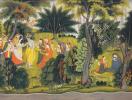
Hinduism has no single word for love – it has a dozen. This guide explains the main ones, surveys how the Vedas, Upaniṣads, Advaita and the Gītā treat love, and then focuses on bhakti, the devotional tradition that made love of God the heart of religious life. Part of our series on love in the world religions.
The words
Arabic distinguishes kinds of love as carefully as Sanskrit does, and the distinctions carry theological weight.
Ḥubb and its near-synonym maḥabba are the general words for love, from a root that also gives the word for a seed. This is the Qur’an’s word: God’s love for human beings and theirs for him are both ḥubb. It covers affection, attachment, preference and devotion, and it is morally neutral – one can have ḥubb for wealth or for God.
ʿIshq is passionate, excessive love: love that has become an affliction. Its root may be connected to a word for a creeping vine that strangles the tree it clings to. The Qur’an never uses it. It was the word of the love poets, and it became the word of the Sufis, precisely because it named a love that overwhelms the lover and cannot be controlled. Nūrī’s trial was about this word.
Wudd or mawadda is warm, steady affection, the love that holds families and friends together. One of the Qur’an’s ninety-nine names of God is al-Wadūd, the Loving, and the word the Qur’an uses for the bond between spouses is mawadda.
Raḥma is mercy or compassion, from the same root as the word for a mother’s womb. Two of God’s names, al-Raḥmān and al-Raḥīm (the Compassionate, the Merciful), head every chapter of the Qur’an but one. Raḥma is not exactly love, but it is the form God’s love takes towards creatures, and the tradition often treats the two together.
Shawq is longing, the ache for what is absent; uns is intimacy or familiarity; riḍā is contentment or glad acceptance. Al-Ghazālī put these three together with maḥabba in the title of his treatise on love, and they are the stations through which the mystics thought love passed.
Hawā is whim, caprice, the pull of appetite – the love that goes wrong. And khulla, intimate friendship, is what God had with Abraham, whom the Qur’an calls khalīl Allāh, the friend of God.
Notice the shape of this vocabulary. It gives the general word (ḥubb) to scripture, the passionate word (ʿishq) to the poets, and the maternal word (raḥma) to God’s own names. The history of the Islamic theory of love is largely the history of these three words being pulled towards one another.
Love in the Qur’an
The Qur’an is not a book about love in the way that, say, the Song of Songs is, but love runs through it. Three points matter for everything that follows.
First, God loves. “He loves them and they love Him,” says a verse (5:54) that the Sufis would quote more than any other, and the reciprocity is exact: God’s love is mentioned first, and it is not contingent on anything. Another verse gives the sequence differently: “Say: if you love God, follow me, and God will love you” (3:31). The Qur’an also says whom God loves – the doers of good, the just, the patient, the God-fearing, those who trust him, those who purify themselves – and whom he does not: aggressors, the arrogant, the corrupt, the unjust. Divine love, in the Qur’an, has content: it responds to character.
Second, human beings love, and their love is a test. “Those who believe are stronger in love for God” than the idolaters are for their idols (2:165). But the Qur’an knows the competition. It speaks of the love of wealth (89:20), of women and children and horses and land (3:14), and it asks its hearers which love will win. The word for all of these is ḥubb: the same love that can be given to God is being given to things.
Third, love is built into creation. “He created for you mates from among yourselves, that you might find rest in them, and He put between you love (mawadda) and mercy (raḥma)” (30:21). This is the Qur’an’s most quoted verse on marriage, and its structure – love and mercy together, both placed there by God – recurs throughout Islamic thought about human relationships. Meanwhile God’s mercy “encompasses all things” (7:156); he “has prescribed mercy upon himself” (6:12); and Muhammad himself was sent “only as a mercy to the worlds” (21:107).
Two sayings of the Prophet complete the scriptural picture. One, in the most authoritative collections, has God say: “My servant keeps drawing near to Me through voluntary acts until I love him; and when I love him, I am his hearing with which he hears, his sight with which he sees, his hand with which he grasps, his foot with which he walks.” The mystics built a whole theology on that. The other is simpler and is the ethical heart of the matter: “None of you truly believes until he loves for his brother what he loves for himself.”
Three theories of love
Out of this material the Islamic intellectual traditions built three broad and competing accounts.
The theologians: love as obedience
The rationalist theologians of the ninth and tenth centuries – the Muʿtazila, and to a lesser degree the Ashʿarīs who succeeded them – were uncomfortable with the idea of God loving or being loved. Love, as they understood it, is an inclination towards what one lacks, a movement of the soul towards a beloved. God lacks nothing and does not move. And love for God seemed equally problematic: how can a finite creature love an infinite being who has no form, no resemblance to anything, and cannot be seen?
Their solution was to reinterpret. God’s love for his servants means his will to reward them and his good pleasure with their obedience. The servant’s love for God means obedience itself, together with love of God’s commands and of the reward he promises. Love is real, but it is a name for something else – for a relationship of command and compliance, not of intimacy. On this view, the Qur’an’s “He loves them and they love Him” describes a God who is pleased with those who obey and servants who obey willingly. Anything more was anthropomorphism.
This was a serious position, and it dominated Sunni theology for a long time. It was also, in the eyes of its critics, a way of explaining away what the Qur’an plainly said. The critics came from two very different directions.
One was al-Ghazālī (c. 1056–1111), the greatest Sunni theologian of the age, who devoted Book 36 of his forty-volume Revival of the Religious Sciences to “Love, Longing, Intimacy and Contentment.” He begins by asserting flatly that love of God is “the highest of the stations and the summit of the degrees,” that everything before it is a preparation for it, and that “whoever denies it denies the whole religion.” Then he takes on the theologians. Love, he says, follows knowledge: we love what we perceive as good, pleasant or beautiful, and we love it in proportion to how well we know it. He sets out five causes of love. We love ourselves and our own continued existence. We love those who do us good. We love those who do good in general, even when it does not touch us. We love beauty for its own sake, whether the beauty of a face or the inner beauty of a noble character. And we love what resembles us, through a hidden affinity between lover and beloved. Al-Ghazālī then argues, case by case, that every one of these causes points supremely to God: he is the source of our existence, our greatest benefactor, the doer of all good, the most beautiful, and the one to whom the human spirit is most akin. His conclusion is stark: “None deserves love save God.” Everything else we love, we love either mistakenly or as a reflection of him.
The other critics were the traditionalists, and their inclusion here surprises some readers, because they are the school least associated with mysticism. Ibn Taymiyya (1263–1328) and his student Ibn Qayyim al-Jawziyya (1292–1350) both attacked the Sufi metaphysics of Ibn ʿArabī as heresy. But they insisted, against the rationalist theologians, that God’s love is literal and that the human love of God is the very essence of worship. Ibn Taymiyya defined ʿibāda, worship, as “the utmost love together with the utmost humility.” Ibn Qayyim wrote an entire treatise, The Garden of Lovers, on the psychology of love, human and divine, and made love the first of the “stations” on the road to God. For the traditionalists, the point was scriptural: the Qur’an says God loves and is loved, and it is not the theologian’s job to soften that. Love of God in Islam is thus not a Sufi peculiarity. It is asserted, in its own idiom, by the most rigorous anti-Sufis.
The philosophers: love as cosmic attraction
The philosophers (falāsifa) inherited Plato and Aristotle through the Neoplatonists, and with them a theory in which love is the force that holds the universe together. Every being desires its own good and perfection; every lower thing yearns towards the higher from which it came; and the whole cosmos is a hierarchy of desire pointing to the One Good at its summit.
Avicenna (Ibn Sīnā, c. 980–1037) gave this its classic Islamic form in a short Treatise on Love (Risāla fī ‘l-ʿishq). Love, he argues, is present in every existing thing, from the elements upward, as the inclination of each thing towards what perfects it. Stones “love” their natural place; plants love nourishment and growth; animals love what pleases their senses; the human soul loves the beautiful and the good; and the Necessary Existent, God, is at once the supreme beloved and the supreme lover, loving his own perfection eternally. Avicenna also does something the theologians would not have dared: he defends human love of beautiful faces. When the rational soul is in charge, he says, love of a beautiful human form is a noble thing, because beauty is a trace of the divine order, and the lover who embraces and kisses the beloved out of a desire for closeness rather than lust is doing nothing shameful. This became a charter for the later poets.
Alongside the philosophers proper there grew an Arabic literature about human love that was equally theoretical. The poets of the seventh and eighth centuries had already produced the ʿudhrī tradition, named after a tribe famous for dying of love – chaste, obsessive, unfulfilled passion, of which Qays and Laylā (Qays being Majnūn, “the madman”) became the archetype. The litterateurs then analysed it. Ibn Dāwūd al-Iṣfahānī (d. 909), the same jurist who prosecuted Nūrī, wrote The Book of the Flower, an anthology-cum-treatise on love that draws on Plato’s idea of souls divided and searching for their other half. Ibn Ḥazm of Córdoba (994–1064), a strict legal scholar, wrote The Ring of the Dove, the most charming book on love in the Arabic language, with chapters on falling in love from a description, on the messenger, on keeping the secret, on the signs of love, on separation and fidelity, on wasting away and on death – and, at the end, on the virtue of continence. Ibn Ḥazm defines love as “a reunion of parts of souls which were separated in this creation,” and he takes for granted that it happens to pious people too.

Laylā and Majnūn faint on meeting; from a manuscript of Niẓāmī's Khamsa copied in Herat in 1431. The Arab love-story became, in Persian hands, an allegory of the soul's love for God.
The Sufis: love as the secret of creation
The third theory is the one the rest of this entry follows, because it is the one that made love the centre of an entire religious world.
The Sufis began as ascetics – renouncers, weepers, people who took the Qur’an’s warnings seriously and fled the wealth of the early caliphate. Love entered this movement early, and by tradition it entered through a woman. Rābiʿa al-ʿAdawiyya of Basra (d. 801), a freed slave who refused marriage and lived in poverty, is credited with the turn from fear to love. Whether the sayings attributed to her are historically hers is doubtful, but they set the tradition’s terms. She is said to have prayed: “O God, if I worship You from fear of Hell, burn me in Hell; if I worship You in hope of Paradise, shut me out of Paradise; but if I worship You for Your own sake, do not withhold from me Your everlasting beauty.” And she is credited with a verse that distinguishes two loves:

The distinction – love as my desire versus love as your due – is the same one the Hindu bhakti theologians drew between kāma and prema, and it does the same work: it makes selflessness the test of love.
From Rābiʿa onwards, love became the Sufi’s defining relation to God, and the ninth and tenth centuries produced a series of figures who pushed it further. Dhū ‘l-Nūn of Egypt spoke of love as the soul’s intoxication. Bāyazīd Bisṭāmī described a state in which the lover vanishes into the beloved and cried out “Glory be to me!” – a saying the sober-minded explained as God speaking through him. Junayd of Baghdad (d. 910), the great systematiser, insisted on sobriety after intoxication and defined love as “the entering of the qualities of the Beloved in place of the qualities of the lover.” And al-Ḥallāj (d. 922) went furthest of all, declaring “I am the Real” (anā ‘l-ḥaqq, the Real being a name of God) and teaching, according to his interpreters, that passionate love was the very essence of God’s own being. He was executed in Baghdad – for political as much as theological reasons – and became the tradition’s martyr of love, the one who said aloud what the others whispered.
The tenth- and eleventh-century Sufi manuals – al-Sarrāj’s Book of Flashes, al-Qushayrī’s Epistle, Hujwīrī’s Unveiling of the Veiled – then did for love what the theologians had done for doctrine: they classified it. Al-Sarrāj distinguishes three degrees. The love of ordinary believers arises from God’s kindness to them: they love him because he is good to them. The love of the sincere arises from contemplating God’s majesty and beauty: they love him for what he is. The love of the knowers arises from knowing that God loved them first, without cause, before they existed: they love because they are loved, and their love is his love returning to its source. This third love was the goal, and it rested on the Qur’anic order of words – “He loves them” before “they love Him.”
The metaphysics of love
What began as the psychology of devotion became, in the twelfth and thirteenth centuries, a metaphysics – an account of why anything exists at all.
The hidden treasure
The Sufis liked to cite a saying in which God declares: “I was a hidden treasure and I loved to be known; so I created the creatures that I might be known.” The saying is not found in the canonical hadith collections, and Ibn ʿArabī himself admitted it was “sound by unveiling but not by transmission” – true, that is, because the mystics had verified it, not because scholars could trace it to the Prophet. But it expressed what they believed the Qur’an implied. When the Qur’an says God created humankind “only to worship Me” (51:56), an early gloss read worship as know. Put the two together and the reason for creation is love: God’s love to be known, and the creature’s answering love for the one who made it in order to be known.
Aḥmad al-Ghazālī and the birth of Persian love-mysticism
The great theologian’s younger brother, Aḥmad al-Ghazālī (d. 1126), wrote the first Persian treatise on love, the Sawāniḥ (“Inspirations”), and it changed the language of Sufism. Where his brother had written of maḥabba and argued carefully from causes, Aḥmad wrote of ʿishq – the poets’ word, Nūrī’s word – and treated it not as an emotion but as a reality in its own right, prior to both lover and beloved. Love, he says, is a bird that comes from the world of the unseen and cannot be caged in words. Its aim is to make the lover into the beloved, to burn away everything in the lover that is not love. He wrote in short, allusive chapters, mixing prose and verse, and he set the pattern for the whole Persian tradition that followed: ʿAṭṭār’s Conference of the Birds, in which thirty birds cross seven valleys of love to find that the king they seek is themselves; Rūzbihān Baqlī’s Jasmine of the Lovers, which defends human love as the apprenticeship for divine love; and, above all, Rumi.
Ibn ʿArabī: the beloved in every beloved
Ibn ʿArabī (1165–1240), the Andalusian whom the later tradition called “the Greatest Master,” produced the most comprehensive Islamic metaphysics of love. His system is usually summarised as waḥdat al-wujūd, “the oneness of being”: there is only one true existence, God’s, and everything else is a self-disclosure of that existence – a place where one or another of God’s names shows itself. Love is the engine of this self-disclosure. God loves to be known; his creative breath is “the breath of the Merciful,” the exhaling of a love that could not stay hidden.
The consequence for human love is radical. Ibn ʿArabī writes that no one has ever loved anything but God – but God is veiled from most lovers under the names of Zaynab, Suʿād, Hind and Laylā. When a man loves a woman, he loves a form in which God has disclosed himself; the trouble is not that he loves but that he does not know whom. Ibn ʿArabī distinguishes three loves: divine love (God’s for us and ours for him), spiritual love (in which the lover seeks the good of the beloved and has no wish of his own), and natural love (in which the lover seeks his own satisfaction). The gnostic holds all three together and sees them as one. In the chapter on Muhammad in his Bezels of Wisdom he goes further than any Muslim thinker before or since: since the most complete self-disclosure of God is in the human form, and since man contemplates God most completely in woman, the love of a man for a woman is potentially the highest contemplation available to him. He was condemned for this by many, and revered for it by more.
Rumi: the reed and the fire
Jalāl al-Dīn Rumi (1207–1273) did not write a treatise on love. He wrote some sixty thousand verses about it, after his encounter, at the age of thirty-seven, with a wandering dervish named Shams of Tabriz turned a respected jurist into a poet who danced. His Masnavī, the “Qur’an in Persian” as later readers called it, opens with the tradition’s most famous image:
Love, for Rumi, is the pain of separation and the pull towards return. The reed-flute’s music is beautiful because it is a cry; the soul is beautiful because it is homesick. He says that love is “the astrolabe of God’s mysteries,” the instrument by which the unseen is measured. He says that whether love comes “from this side or from that,” from a human face or from heaven, “in the end it leads us yonder” – the Sufi principle that the metaphorical is the bridge to the real, that love for a creature, honestly followed, arrives at the Creator. And he says that when he tried to explain love, the intellect “lay down in the mud like a donkey”: only love can explain love. Rumi’s poetry is where the three Arabic words finally fuse. It is ʿishq, all passion and madness; it is maḥabba, the Qur’an’s mutual love of God and servant; and it is raḥma, because the God the lover finds at the end is the one who breathed him out of mercy.

A folio from a 1663 manuscript of Rumi's Masnavī, the poem the Persian tradition called the Qur'an in Persian. Walters Art Museum.
Annihilation and return
Two technical terms hold this tradition together. Fanāʾ is annihilation: the passing away of the lover’s self in the beloved, the state Bāyazīd and Ḥallāj gave voice to and Junayd warned about. Baqāʾ is subsistence: the return from that state, in which the lover lives again in the world but now as God’s instrument – the hearing, sight and hand of the hadith. The mature Sufi teaching is that fanāʾ without baqāʾ is incomplete. Love’s goal is not to disappear but to come back transformed, so that, as Junayd said, the qualities of the Beloved replace the qualities of the lover. Layla and Majnun became the parable for this. Majnūn, wandering the desert and speaking to Laylā in the wind, is the soul that has lost itself; the poets who retold the story – Niẓāmī in 1188, then Amīr Khusraw, Jāmī and dozens of others – made him the model of the lover who wants nothing for himself.
Practice
None of this was merely theoretical. The Sufi orders that spread across the Islamic world from the twelfth century organised love as a discipline. Dhikr, the rhythmic remembrance of God’s names, was understood as the lover repeating the beloved’s name. Samāʿ, listening to music and poetry, sometimes with movement – the whirling of Rumi’s Mevlevī order is the best-known form – was defended as a way of stirring the love that ordinary religious observance left dormant. The relationship with the shaykh, the master, was itself a school of love: the disciple learnt to love God by first loving someone who loved God. And love for the Prophet, expressed in poetry, in celebration of his birthday and in the constant blessing of his name, was the form of love that even the most sober jurists shared with the most ecstatic dervishes.
Love in the ordered life
Beside all this, and for most Muslims in front of it, stands the love that Islamic law and ethics regulate: love within the family, the community and the wider world.
Marriage is the paradigm. The Qur’an’s “love and mercy” between spouses, its image of husband and wife as “garments for one another” (2:187), and the Prophet’s reported saying that “the best of you are those who are best to their wives” set the tone. Islamic law treats marriage as a contract, not a sacrament, but the ethical literature treats it as a school of the virtues, and the biographies dwell on Muhammad’s grief at the death of his first wife Khadīja and his tenderness towards ʿĀʾisha. Love between spouses was never regarded as a rival to love of God; it was one of God’s signs.
Brotherhood (ukhuwwa) among believers is the second circle. “None of you believes until he loves for his brother what he loves for himself” is the ethical minimum, and the tradition developed a whole vocabulary around al-ḥubb fī Allāh, “love for God’s sake” – loving another person not for what they give you but because you share a love of God. A hadith promises God’s shade on the Day of Judgement to “two people who loved one another for God’s sake, who met for that and parted for that.”
In Shīʿī Islam, love takes a further form. The Qur’an has the Prophet say “I ask of you no reward except love (mawadda) for the near of kin” (42:23), and Shīʿīs read this as commanding love for the Prophet’s family, the Ahl al-Bayt, above all ʿAlī and his descendants, the Imams. This love, walāya, is not an emotion added to faith but its core: a saying attributed to the sixth Imam, Jaʿfar al-Ṣādiq, asks “Is religion anything but love?” The grief of Karbala, mourned every year, is love in the form of lamentation, and the Shīʿī poetic tradition, in Arabic, Persian and Urdu, is among the most passionate devotional literature in Islam.
Finally, there is compassion for all creatures. The Prophet is reported to have said that “the merciful are shown mercy by the Merciful,” and that God’s mercy extends to whoever shows mercy to what is on earth. Whatever the theologians made of ḥubb, no one disputed raḥma, and it was through raḥma that the love of God was understood to reach everything that lives.
Love of God and love of others
Does the mystics’ insistence that “none deserves love save God” leave room for loving human beings? The Islamic traditions give two answers, and they mirror the two given in Hinduism.
The first is Ibn ʿArabī’s: since God discloses himself in every creature, to love a creature rightly is to love God, and the only mistake is to stop at the creature. The Persian poets made this into a method. The love of a human face is ʿishq-i majāzī, metaphorical love; it is real, it is not to be despised, and it is the bridge to ʿishq-i ḥaqīqī, love of the Real. One who has never loved anything cannot love God.
The second is al-Ghazālī’s, and it is more austere: everything we love, we love as a reflection of God’s qualities, and once we understand this, our love for creatures does not disappear but is put in its place – it becomes love of God’s handiwork, of his generosity shown through people, of his beauty shining in a face. Al-Ghazālī does not want us to love our families less. He wants us to know whom we are really loving when we love them.
In practice the two converge. The Sufi who has loved God through a shaykh, a spouse and a friend does not love them less afterwards; the ethical tradition that made “love for God’s sake” the highest form of friendship did not thereby make friendship cold. What the Islamic tradition resists, from the Qur’an’s verses on the love of wealth to Rumi’s warnings about clinging to forms, is love that stops – love that treats its object as the end rather than the sign.
Relevance to life
Two loves. Rābiʿa’s distinction between loving from longing and loving because the beloved is worthy is a question worth asking of any attachment: do I love this for what it does for me, or for what it is? The tradition’s answer – that the first is not wrong, but the second is what love is for – is generous without being naive.
Love follows knowledge. Al-Ghazālī’s claim that we love in proportion to how well we perceive the beloved’s goodness reverses the modern assumption that love is blind. On his account, love is a form of seeing. Where love fails, the remedy may not be more feeling but more attention.
The metaphorical is the bridge to the real. The Persian principle that human love, honestly followed, leads beyond itself is a rebuke to two opposite errors: the puritan’s, who fears earthly love as a distraction, and the romantic’s, who treats it as the end of all things. The Sufis say it is neither. It is a road.
Separation is not failure. Rumi’s reed sings because it was cut. The tradition’s insistence that longing, absence and homesickness are not defects in love but its most honest expression has consoled readers across every religious line for seven hundred years.
Love is disciplined. The orders that built dhikr, samāʿ and the master-disciple bond into a curriculum understood that love, left alone, fades. What sustains it is practice: naming, remembering, gathering, singing. That is as true of a marriage or a friendship as of a mystical path.
Mercy first. Whatever else the traditions disputed, they agreed that God’s love for creatures takes the form of raḥma – and that a human being’s love, if it is to resemble God’s, must too. The word’s root is the womb. Love, in Islam, begins with the recognition that something has been carried.
◊ ◊ ◊
Where to start reading
- William C. Chittick, Divine Love: Islamic Literature and the Path to God (Yale, 2013) – the best single book on the subject: a survey of the Persian and Arabic love-literature, mostly in translation, with a lucid introduction.
- Al-Ghazālī, Love, Longing, Intimacy and Contentment, translated by Eric Ormsby (Islamic Texts Society, 2011) – Book 36 of the Revival of the Religious Sciences, the theologians’ great treatise on love of God.
- Annemarie Schimmel, Mystical Dimensions of Islam (North Carolina, 1975) – the classic history of Sufism, with a long chapter on love.
- William C. Chittick, The Sufi Path of Love: The Spiritual Teachings of Rumi (SUNY, 1983) – Rumi’s thought arranged by theme, in careful translation. His The Sufi Path of Knowledge (SUNY, 1989) does the same for Ibn ʿArabī.
- Rumi, The Masnavi, translated by Jawid Mojaddedi (Oxford World’s Classics, 2004–) – the first complete modern verse translation; Book One contains the reed-flute and most of the passages quoted above.
- Ibn Ḥazm, The Ring of the Dove, translated by A. J. Arberry (Luzac, 1953) – the Andalusian treatise on human love, still in print and still delightful.
- Niẓāmī, Layli and Majnun, translated by Dick Davis (Penguin, 2021) – the Persian poem that turned the Arab love-story into a mystical allegory.
- Joseph E. B. Lumbard, Aḥmad al-Ghazālī, Remembrance, and the Metaphysics of Love (SUNY, 2016) – on the Sawāniḥ and the birth of Persian love-mysticism; includes a translation.
- Rkia Elaroui Cornell, Rabiʿa from Narrative to Myth (Oneworld, 2019) – what can and cannot be known about the woman who made love the heart of Sufism.
- Binyamin Abrahamov, Divine Love in Islamic Mysticism (Routledge, 2003) – on al-Ghazālī and al-Dabbāgh; a scholarly study of the theological arguments.
- Ghazi bin Muhammad, Love in the Holy Qur’an (Kazi, 2010) – an exhaustive survey of the Qur’anic vocabulary of love by a contemporary Muslim scholar.
- Carl W. Ernst, Sufism: An Introduction to the Mystical Tradition of Islam (Shambhala, 1997) – the best short orientation to the Sufi tradition as a whole.
Read more
- Ibn ʿArabī – Stanford Encyclopedia of Philosophy. The Greatest Master’s metaphysics, including his theory of love.
- Al-Ghazālī – Stanford Encyclopedia of Philosophy. The theologian who made love of God the summit of the religious life.
- Al-Ghazālī – Internet Encyclopedia of Philosophy. A complementary account, with attention to his life and spiritual crisis.
- Avicenna (Ibn Sīnā) – Internet Encyclopedia of Philosophy. The philosopher whose Treatise on Love made love a cosmic principle.
- Mysticism in Arabic and Islamic Philosophy – Stanford Encyclopedia of Philosophy. How the philosophers and the Sufis borrowed from one another.
- Al-Ghazālī – Encyclopaedia Britannica. A concise biography, including his role in making Sufism acceptable to orthodoxy.
- Sufism – Encyclopaedia Britannica. An overview of the mystical tradition, its history and its practices.
- Layla and Majnun – Wikipedia. The story, its Arabic origins and its Persian and Turkish retellings.