Bad Faith
Sartre on the lies we tell ourselves about our own freedom
Everyone knows what it is to lie to someone else. But can you lie to yourself? To do so, you would have to know the truth (otherwise you are just mistaken) and at the same time not know it (otherwise you are not deceived). Jean-Paul Sartre’s concept of bad faith (mauvaise foi) is his answer to this puzzle – and his diagnosis of the most common way in which human beings run away from their own freedom. It is the central moral idea of Being and Nothingness (1943), and it has become one of the few technical terms of twentieth-century philosophy that people use in everyday conversation.

What is bad faith?
To understand bad faith, we need two of Sartre’s basic distinctions.
The first is between two kinds of being. A stone, a table or a cup of coffee simply is what it is. It has no inner distance from itself, no possibilities, no awareness. Sartre calls this being-in-itself. Human consciousness is different. I am always aware of myself, and that awareness opens up a gap: I can step back from what I have been and ask what I will do next. Sartre calls this being-for-itself. Its strange structure is captured in one of his most famous formulas: human reality “is what it is not, and is not what it is.” I am not simply my past, my job or my character, because I can always take a stance towards them; and what I am “not yet” – my projects and possibilities – is nevertheless what defines me.
The second distinction is between facticity and transcendence. Facticity is everything about my situation that is simply given: my body, my past, my nationality, the fact that I am sitting in this café and not somewhere else. Transcendence is my freedom to go beyond those givens, to interpret them, to make something of them. Every human life is both at once. I cannot escape my facticity, but neither can I be reduced to it.
Bad faith is what happens when I try to collapse this double structure into one of its halves. Either I pretend that I am nothing but my facticity – a fixed thing with a fixed nature, to which my choices do not really belong – or I pretend that I am pure transcendence, a free spirit hovering above my situation, untouched by what my body is doing or what my past has made of me. In both cases I am using my freedom to deny my freedom. That is why Sartre insists bad faith is not a mistake but a project: something I do, and keep doing, because the truth is uncomfortable.
And the truth, for Sartre, is uncomfortable. We are “condemned to be free”: nobody chose to exist, but having been thrown into existence, each of us is responsible for everything we make of it. There is no human nature, no God and no set of values that can take that responsibility off our hands. The feeling that accompanies this realisation is anguish. Bad faith is, in the end, the flight from anguish.

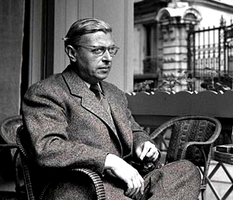
Jean-Paul Sartre in 1950. Source: Wikimedia Commons.
Sartre’s examples
Sartre was a novelist and playwright as well as a philosopher, and his argument is carried by a handful of vivid scenes.
The waiter. The most famous one is the café waiter whose every gesture is slightly overdone: his movements are “a little too precise, a little too rapid,” his bow a little too eager. He is, Sartre says, playing at being a waiter, the way a child plays at being a soldier. Society demands this of him – Sartre remarks that a grocer who daydreams is offensive to his customers, because we want our tradesmen to be nothing but tradesmen. But the waiter cannot actually be a waiter the way an inkwell is an inkwell. He is a free human being who has to get up every morning and choose, once again, to put on the apron. In throwing himself into the role, he hides this from himself. He has made himself into a thing.
The woman on a first date. Sartre’s second example is a young woman whose companion is clearly making advances. She knows what his compliments mean, but she chooses to hear them only as polite admiration of her personality. Then he takes her hand. If she withdraws it, the pleasant evening is over; if she leaves it there, she has consented. So she does neither: she launches into an animated conversation about life and ideas, and lets her hand rest in his as though it were an object that had nothing to do with her. She has split herself in two – a pure mind that is above all this, and a body that is merely a thing. That split, says Sartre, is bad faith.
The homosexual and the champion of sincerity. The third case is subtler and shows that bad faith can take opposite forms. A man who has had homosexual relationships refuses to call himself a homosexual. His friend, the “champion of sincerity,” urges him: just admit what you are! Sartre finds bad faith on both sides. The man is in bad faith when he pretends his acts have nothing to do with who he is – that is denying his facticity. But the friend is in bad faith too, because he wants his companion to confess to being a homosexual the way a table is a table – to accept a fixed essence and stop being free. Sincerity itself, Sartre concludes, can be a form of bad faith when it demands that we “be what we are” in the manner of things.
Once you have the pattern, examples multiply. “I’m just not a creative person.” “I had no choice; everyone in my position would have done the same.” “That’s not who I am, it was the alcohol talking.” “I’m a mother, so of course I had to give up my plans.” The content differs, but the move is identical: a free agent recasting herself as the product of a nature, a role or a circumstance, so that the choice – and the responsibility – disappears from view.
Why a lie to oneself is possible
Sartre’s deepest philosophical opponent in this chapter is Freud. Psychoanalysis seems to offer an elegant solution to the puzzle of self-deception: there is a conscious self that is deceived and an unconscious that does the deceiving, with a “censor” between them. Sartre objects that this only moves the problem. The censor must know what it is repressing in order to repress it, and must at the same time hide this knowledge from itself. The lie to oneself has simply been relocated inside the mind.
His own answer is that bad faith is not a matter of hidden knowledge but of how one chooses to believe. Bad faith works by lowering its standards of evidence. It decides in advance to be satisfied with half-convincing reasons, and it flits between the two aspects of human existence – “I am a waiter” when it suits me, “I am not really a waiter” when it does not – without ever letting them meet. It is a precarious state, which is why it needs constant maintenance, and why the truth is never completely out of reach. The person in bad faith, Sartre says, is always dimly aware of what he is doing. That is what makes it bad faith rather than ignorance.
Is there a way out? Sartre hints, in a famous footnote, at authenticity: a “self-recovery” of a being that had previously been corrupted. But he never developed it in Being and Nothingness, and the promised book on ethics was never finished. The fullest account of what an existentialist ethics might look like came from Simone de Beauvoir, in The Ethics of Ambiguity (1947), where the honest alternative to bad faith is to assume our ambiguity – to accept that we are both facticity and freedom, and to will the freedom of others as well as our own.

Sartre’s discourse “Existentialism is a Humanism” can be broken down into five concepts: Existence precedes essence, Freedom, Responsibility, Anguish and Bad Faith.
Bad faith and its relatives
Sartre did not invent the idea that most people live in flight from themselves. He gave a new, sharply focused name to a worry that runs through modern thought. Three comparisons bring out what is distinctive about his version.
Heidegger: authenticity and “the they”
Sartre’s analysis grows directly out of Martin Heidegger’s Being and Time (1927), which he studied intensively as a prisoner of war. Heidegger describes how human existence (Dasein) is, for the most part, absorbed in the public, average way of doing things: what “one” does, what “they” say (das Man). We think the thoughts that are in circulation, feel what one is supposed to feel, and are relieved that nobody in particular has to decide anything. Heidegger calls this inauthenticity (Uneigentlichkeit) and the movement into it falling. What can pull us out of it is anxiety and, above all, the honest confrontation with our own death, which no one can undergo for us and which throws us back on our individual existence. Authenticity (Eigentlichkeit, literally “ownness”) is taking over one’s thrown situation as one’s own.
The family resemblance to bad faith is obvious, but the differences are instructive. Heidegger insists that inauthenticity is not a moral failing and not a “lower” kind of existence; it is the default condition from which authenticity is wrested, and to which we always return. Sartre’s bad faith, by contrast, is unmistakably an accusation: it is a lie, and the person telling it is responsible. Second, Heidegger’s analysis is primarily social – the pull of “the they” – whereas Sartre’s is primarily about the individual’s relation to her own freedom. And third, Heidegger avoids the vocabulary of freedom and choice almost entirely; in his Letter on Humanism (1947) he explicitly rejected Sartre’s existentialism as still too centred on the human subject.
Nietzsche: herd morality and becoming who you are
Half a century earlier, Friedrich Nietzsche had already argued that the morality of modern Europe is “herd animal morality” (Beyond Good and Evil, §202): a system of values that rewards timidity, sameness and obedience, and that calls these things “good” because the herd finds them safe. In On the Genealogy of Morality (1887) he traced such values to ressentiment, the slow revenge of the weak on the strong, who redefine their own inability to act as a virtue. Against the herd, Nietzsche set the task of “becoming who you are” – the subtitle of Ecce Homo – through self-creation and the honest acceptance of one’s fate (amor fati).
Nietzsche is also a master analyst of self-deception. One aphorism reads, in effect: my memory says I did this; my pride says I cannot have done it, and remains adamant; eventually memory gives in. That is a portrait of bad faith before the term existed, and Sartre’s account of consciousness lowering its own standards of evidence owes a good deal to it.
But the two thinkers part company on the crucial point. Nietzsche regarded free will as a fiction invented by priests in order to hold people responsible and punish them; for him, we are what our drives and our history have made us, and the task is to affirm that. Sartre regarded freedom as the inescapable truth about human beings and the denial of it as the primal lie. For Nietzsche, the herd is the problem; for Sartre, the problem is inside each of us, herd or no herd. And where Nietzsche’s critique targets a particular set of values, Sartre’s bad faith is neutral about content – one can be in bad faith as a conformist, but equally as a rebel who pretends his rebellion is simply “who he is.”

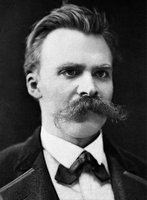
Friedrich Nietzsche, 1882. Source: Wikimedia Commons.
Fromm: the escape from freedom
Erich Fromm’s Escape from Freedom (1941; published in Britain as The Fear of Freedom) appeared two years before Being and Nothingness and asks a strikingly similar question from a different direction. Fromm, a psychoanalyst and social theorist, wanted to understand why the citizens of a modern democracy had handed themselves over to Hitler. His answer: modern history had given people “freedom from” traditional authorities – church, guild, village, fixed social station – without giving them the inner resources for “freedom to” live spontaneously and productively. The result is isolation and anxiety, and from anxiety people flee. Fromm identifies three mechanisms of escape: authoritarianism (submitting to a powerful leader or dominating others), destructiveness (eliminating the world that makes one feel powerless) and automaton conformity – becoming exactly what one’s culture expects, so that the gap between self and world disappears. The conformist, Fromm says, is convinced that his thoughts and wishes are his own, when in fact they have been supplied from outside; he has a pseudo-self in place of a self.
Automaton conformity is bad faith described in the language of social psychology, and Fromm’s picture of the anxious individual who would rather be a thing than be alone is very close to Sartre’s. The difference lies in the explanation. Fromm is a social thinker: whether people escape from freedom depends on historical and economic conditions, on how they were raised and on what kind of society they live in, and the cure is partly social – a society that supports love, productive work and genuine community. Sartre is a philosopher of consciousness: bad faith is a permanent possibility of the human mind as such, available in any society and at any moment, and the only remedy is the individual’s own lucidity. Fromm, in short, tells us why people flee from freedom; Sartre tells us what the flight consists in.
The three comparisons can be summed up briefly. Heidegger describes the social pull of inauthenticity without moral blame. Nietzsche attacks a particular herd morality and denies the freedom Sartre affirms. Fromm explains the flight from freedom through history and psychology. Sartre’s distinctive contribution is to locate the flight in the structure of consciousness itself and to insist that, however understandable it is, it is always a choice.

Erich Fromm claims that freedom itself can sometimes be the cause of fear and anxiety, forcing us to find ways to “escape from freedom.” Authoritarianism, destructiveness and automaton conformity are three ways how we try to cope with the freedom we fear.
Criticisms
Sartre’s concept has attracted three main objections.
Is everyone in bad faith? Sartre sometimes writes as if every role and every settled identity were a flight from freedom. Critics object that this makes the concept useless: if the waiter is in bad faith simply by doing his job well, so is everyone who has ever committed to anything. Some readers (Leslie Stevenson, Robert Bernasconi) argue that Sartre never meant the waiter himself to be a straightforward case of bad faith – his point is about the demand that a person coincide with a social function.
Does it ignore oppression? Feminist and Marxist critics have pointed out that it is easy to tell people to own their freedom when one is a Parisian intellectual. The young woman on the date is in a situation that has been made for her by a culture that punishes both refusal and consent. Beauvoir’s The Second Sex already begins to shift the emphasis towards the social situations that make freedom harder to exercise, and the later Sartre, increasingly influenced by Marxism, conceded a great deal to this line of criticism.
Is the psychology right? Sartre’s rejection of the unconscious is bold, and few psychologists have followed him. But his core insight – that self-deception is motivated, that it works by managing one’s attention and standards of evidence rather than by hiding information in a separate compartment – has been taken up by analytic philosophers of self-deception and is well supported by research on motivated reasoning.
Relevance to life
Bad faith is one of those philosophical ideas that, once learned, cannot be unlearned. A few ways in which it earns its keep:
Listen for “I had no choice." The phrase is sometimes true, but far less often than we say it. Usually it means: “I had a choice, and I did not like the alternatives.” Saying that instead is more honest, and oddly more bearable.
Beware of the role that does your deciding for you. Being a good professional, a good parent or a good partner is admirable. Letting “a person like me does X” replace actual judgement is bad faith. Sartre’s waiter is not wrong to be a waiter; he is wrong to disappear into it.
Beware the opposite escape too. The young woman’s trick – “my real self is elsewhere, this is just my body / my job / my circumstances” – is just as evasive as the waiter’s. People who keep their “true self” in reserve for some future life are often avoiding responsibility for the one they are actually living.
Do not confuse self-knowledge with self-definition. Sartre’s “champion of sincerity” shows that labelling yourself (“I am an introvert,” “I am an anxious person”) can be a way of closing a door. Your past is real, but it is not a verdict.
Treat anxiety as information. Sartre, Heidegger and Fromm agree on one thing: the discomfort of freedom is not a malfunction. It is what being free feels like. The question is not how to get rid of it but what it is pointing to – usually a decision one is pretending not to have.
Remember what Fromm adds. Individual lucidity is not the whole story. Societies, workplaces and families can be organised so that bad faith is easy and honesty is punished. Part of living well is building environments – and relationships – in which people are allowed to be free.
◊ ◊ ◊
Where to start reading
- Jean-Paul Sartre, Being and Nothingness, Part One, Chapter Two (“Bad Faith”) – about thirty pages, and by far the most readable section of the book. All the examples discussed above are here.
- Jean-Paul Sartre, Existentialism Is a Humanism – the short 1945 lecture that explains the ideas of freedom, anguish and responsibility that bad faith presupposes.
- Simone de Beauvoir, The Ethics of Ambiguity – the best account of what the alternative to bad faith might look like.
- Martin Heidegger, Being and Time, §§25–27 and §§35–38 – on “the they,” idle talk and falling.
- Friedrich Nietzsche, Beyond Good and Evil, Part Five (“On the Natural History of Morals”) – the critique of herd morality.
- Erich Fromm, Escape from Freedom, Chapter 5 (“Mechanisms of Escape”) – authoritarianism, destructiveness and automaton conformity.
The standard English translation of Being and Nothingness is by Hazel Barnes (1956); a new translation by Sarah Richmond (2018) is more accurate and has helpful notes.
Read more
- Jean-Paul Sartre – Stanford Encyclopedia of Philosophy. Includes a careful discussion of bad faith and its interpretations.
- Existentialism – Stanford Encyclopedia of Philosophy. Sets bad faith in the context of the wider movement, including Heidegger and Nietzsche.
- Jean-Paul Sartre: Existentialism – Internet Encyclopedia of Philosophy. A more accessible overview of Sartre’s early philosophy.
- Martin Heidegger – Stanford Encyclopedia of Philosophy. See the sections on “das Man,” falling and authenticity.
- Nietzsche’s Moral and Political Philosophy – Stanford Encyclopedia of Philosophy. On herd morality, slave morality and Nietzsche’s view of free will.
- Erich Fromm – Internet Encyclopedia of Philosophy. Covers Escape from Freedom and the mechanisms of escape.
- Self-Deception – Stanford Encyclopedia of Philosophy. For readers who want to follow the puzzle of lying to oneself into contemporary philosophy.