Plato: Lysis
Socrates, two boys and the question nobody can answer: what is a friend?
The Lysis is the shortest and least famous of Plato’s dialogues about love, and the only one devoted entirely to friendship. It is also, by common consent, a failure: after twenty-odd pages of argument, Socrates and two teenage boys admit that they have not been able to say what a friend is. Yet it is a failure that has kept philosophers busy for two and a half thousand years. Every later theory of friendship – Aristotle’s above all – is in some way an attempt to answer the puzzles that this little dialogue leaves hanging in the air on a festival afternoon in Athens.

The setting
Unlike most of Plato’s works, the Lysis is narrated by Socrates himself, which gives it an unusually intimate, anecdotal tone. He is walking along the road outside the city wall, from the Academy towards the Lyceum, when a group of young men call him over to a newly built wrestling school. They are celebrating the Hermaea, a festival of Hermes at which, exceptionally, boys and older youths mix freely.
Among them is Hippothales, who is hopelessly in love with a boy named Lysis and makes a fool of himself about it. His friend Ctesippus complains that Hippothales does nothing but compose poems and speeches praising Lysis – not even the boy himself, but his wealthy ancestors, their horses and their chariot victories, “old wives' tales” that everyone has heard before. Socrates gently points out the practical problem. Praising someone you have not yet won over makes him vain, and the vainer he becomes the harder he is to catch; a real hunter does not scare off the game. Hippothales asks how one should talk to a beloved. Socrates offers to show him.
The dialogue thus has two layers from the start. On the surface it is a philosophical inquiry into friendship. Underneath, it is a demonstration – the only one in Plato – of how Socrates thinks a lover ought to speak to the person he loves: not with flattery, but with questions that make him think.
A word about the social setting is needed here. Hippothales' passion for a younger boy belongs to the Athenian institution of paiderastia, the courtship of adolescent boys by older youths, which Plato’s readers took for granted and which Plato himself treats with a mixture of acceptance and criticism. The Lysis does not defend or attack the practice; it simply redirects it. The best thing a lover can do for the beloved, Socrates implies, is to make him wiser.

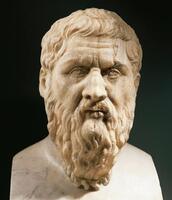
Plato. Roman copy of a portrait by Silanion, Capitoline Museums, Rome. Source: Wikimedia Commons.
Part one: how to talk to someone you love
Lysis comes over, shy at first, with his close friend Menexenus, a sharp and argumentative boy who is also Ctesippus' cousin. When Menexenus is briefly called away, Socrates turns to Lysis.
Do your parents love you very much? Of course. Then they want you to be happy? Yes. And a man is happy if he can do what he likes? Surely. So they let you do whatever you want? Lysis laughs: certainly not. He is not allowed to drive the family’s chariot or even the mule cart, and in all these things he is under the orders of a slave, his paidagogos, who takes him to school. At school he is told what to write and what to recite.
Why do his parents, who love him, treat him like this? Lysis suggests: because he is still young. Socrates shows this cannot be the whole answer. When it comes to reading and playing the lyre, which Lysis knows how to do, his parents let him do as he thinks best. The real reason is not age but knowledge. Where Lysis understands something, people trust him; where he does not, they do not, however much they love him. Even the Great King of Persia would hand over his cooking pot to a stranger rather than to his own son, if the stranger understood cooking and the son did not.
The conclusion is stated in one of the dialogue’s most quoted sentences:
“If you become wise, my boy, all men will be your friends and kindred, for you will be useful and good; but if you are not wise, neither father, nor mother, nor kindred, nor anyone else, will be your friends.” (210d)
This is tough love. Socrates has deflated the pampered aristocratic boy in a few minutes – and he glances at Hippothales, who is hiding in the crowd, to make sure the lesson has landed: this is how you talk to someone you love. But Lysis is not crushed. He is delighted, and when Menexenus comes back he asks Socrates to do the same to his friend.
Part two: what is a friend?
Socrates introduces the main question with a confession that is one of the most charming passages in Plato:
“I have a passion for friends; and I would rather have a good friend than the best cock or quail in the world; I would even go further, and say the best horse or dog. Yea, by the dog of Egypt, I should greatly prefer a real friend to all the gold of Darius, or even to Darius himself: I am such a lover of friends as that.” (211e)
And yet, he says, although Lysis and Menexenus have managed to become friends while still boys, he himself, an old man, does not even know how one person becomes the friend of another. Perhaps Menexenus can tell him. What follows is a chain of attempted definitions, each of which collapses. They are easier to follow if we number them.
1. Is the friend the one who loves, the one who is loved, or both? If friendship requires love on both sides, then a parent cannot be a friend to the baby who screams at her, and a lover of horses, of wine or of wisdom (a philo-sophos) is not a friend of what he loves, since horses and wine love nobody. But if the friend is simply whoever is loved, then a person could be the friend of someone who hates him, and the enemy of someone who loves him – which is absurd. And if the friend is the one who does the loving, we get the same absurdity from the other side. Menexenus is stumped.
2. Is like the friend of like? Socrates turns to the poets, “the fathers and guides of wisdom,” and to Homer’s line that “God ever draws like to like.” But bad people are not really like one another – they are unstable, at odds even with themselves – so this could only hold for the good. And here is the real difficulty: what use can one good person be to another who is exactly like him? Whatever one can do for the other, the other can already do for himself. The good person, insofar as he is good, is self-sufficient, and someone who needs nothing has no reason to cherish anyone. Like is not the friend of like.
3. Is the opposite the friend of its opposite? Hesiod says that potter envies potter and bard envies bard; perhaps, then, friendship is between unlikes – the dry loves the wet, the sick man loves the doctor, the poor man the rich. But if opposites are friends, then the just would be the friend of the unjust and the good of the bad, and, worst of all, the friend would be the friend of the enemy. This fails too.
4. Is the neither-good-nor-bad the friend of the good, because of the presence of bad? This is Socrates' most elaborate proposal. Think of the body: in itself neither good nor bad, it becomes the friend of medicine because illness is present in it. Think of the person who loves wisdom: not wise (or he would not need it) but not hopelessly ignorant either (or he would not want it), aware of his ignorance and reaching out for what he lacks. Socrates is pleased with this – “like hunters who have their prey” – but almost immediately becomes suspicious of his own success.
5. The first friend. Everything we call dear, he notices, seems to be dear for the sake of something else. The patient values the doctor for the sake of health; and health is valued for the sake of something further. This cannot go on forever. There must be something that is dear for its own sake, not for anything beyond it:
“Must we not then arrive at some first principle of friendship or dearness, for the sake of which, as we say, all other things are dear, and which is not dear for the sake of anything else?” (219c–d)
Socrates calls this the first friend (prōton philon). Everything else we love is dear only as an image or reflection of it. A father who prizes his son above everything would, if the boy drank poison, suddenly treasure the wine that could cure him and even the cup that held it – but only for the son’s sake. All our other friendships, Socrates suggests, are like the cup. And if that is so, the real object of friendship cannot be loved “because of the bad,” since if all evils vanished we would still love it. The fourth definition is wrong, or at least incomplete.
6. Friendship as desire for what belongs to us. If we strip away the bad, desire remains: hunger and thirst would exist even in a world without harm. What desires something is a friend to it, and we desire what we lack – what has been taken from us, what is properly ours. So friendship, love and desire are all directed at the oikeion, “what belongs to us,” our own kin. Hippothales, listening in the crowd, turns every colour of the rainbow with pleasure: at last a definition that suits a lover! But Socrates presses on. Is “belonging” the same as “being alike”? Then we are back at the self-sufficiency problem of definition 2. Does the good belong only to the good? Then the bad would be friends of the bad, which has been refuted. Does the good belong to everyone? Then only the good are friends, which has also been refuted.
The ending
At this point Socrates wants to call in one of the older men to help, but the boys' slave attendants, who have been drinking at the festival and shout at them in bad Greek, arrive to take them home. The dialogue closes with Socrates' summary:
“O Menexenus and Lysis, how ridiculous that you two boys, and I, an old man who would fain be one of you, should imagine ourselves to be friends – this is what the bystanders will go away and say – and as yet we have not been able to discover what is a friend!” (223b)
The ending is a joke, but a pointed one. Everything that has happened in the dialogue – the teasing, the affection between Lysis and Menexenus, the boy’s eagerness to share Socrates with his friend, Socrates' own evident fondness for them – is friendship in action. The failure to define it is dramatised against a background of friendship actually taking place. Whether Plato thinks this undercuts the inquiry or completes it is one of the dialogue’s enduring questions.

Plato’s Symposium is one of humanity’s immortal texts on love. Seven friends gather at a party one night in ancient Athens and discuss the nature of love.
Why the Lysis matters
In Plato’s work. The Lysis belongs to the group of early or “Socratic” dialogues – with the Laches on courage, the Charmides on moderation and the Euthyphro on piety – in which Socrates asks “What is X?” and ends in aporia, honest perplexity. These are the dialogues closest to the historical Socrates, and the Lysis shows his method at its most characteristic: start from what everyone says, test it, and watch it fall apart. But the dialogue also looks forward. The idea of a “first friend” for the sake of which everything else is dear anticipates the Form of the Good in the Republic; the picture of love as desire for what belongs to us reappears in Aristophanes' myth of the divided halves in the Symposium; and the thought that the lover of wisdom is someone between ignorance and knowledge is exactly how Diotima describes Eros in that same dialogue. Many of the ingredients of Plato’s mature theory of love are present here in rough form.
For philosophy. The Lysis is the first systematic treatment of friendship in Western thought, and it set the agenda. When Aristotle opens Book VIII of the Nicomachean Ethics by noting that people disagree about whether friendship is based on likeness or on opposition, he is summarising Socrates' second and third puzzles. His famous three kinds of friendship – of utility, pleasure and virtue – answer the first puzzle (friendship must be reciprocal and mutually known, so wine lovers are not friends of wine). And his long discussion of whether the self-sufficient happy person needs friends at all (Nicomachean Ethics IX.9) is a direct response to Socrates' argument that the good person needs nothing. Later thinkers from Cicero to Montaigne to Kant inherited the same questions.

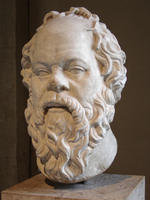
Socrates. Roman marble, Louvre. Source: Wikimedia Commons.
As a puzzle. The Lysis raises two problems that have never been fully solved. One is the tension between love and need: if I love you because you fill a lack in me, my love seems selfish; if I lack nothing, why would I love you at all? The other is the problem of the final object: do I really love my friends for themselves, or for the sake of something else – happiness, the good – of which they are only “images”? Readers have found this second idea cold, even shocking. Others point out that Socrates immediately expresses doubts about it, and that the dialogue’s dramatic action, with its unforced affection, is Plato’s way of telling us that friends are not merely cups.

In this mini-series of posts, we trace the history of the concept of love from Plato and Aristotle through the Christian world to the Desert Fathers.
Relevance to life
The Lysis is a dialogue about a question most of us think we can answer, and its value lies in showing that we cannot – at least not easily.
Flattery is not love. Hippothales thinks he is honouring Lysis by praising him. Socrates shows that he is really making him worse. The people who love us best are not those who tell us how wonderful we are but those who help us become more capable and more honest with ourselves.
Trust is earned by competence, not by affection. Lysis' parents adore him and still will not let him drive the cart. Socrates' point is uncomfortable but true in family life, in work and in politics: being loved does not entitle one to be trusted, and wanting to be trusted means becoming worth trusting.
Ask what your friendships are for. Socrates' chain of “for the sake of” is a useful exercise. Do I value this person for themselves, or as a means to comfort, status or entertainment? The question can be unsettling, but it is also the beginning of taking a friendship seriously.
Need is not shameful. Several of the puzzles stem from the assumption that a perfect person would need no one. Socrates' sixth proposal quietly rejects this: to be a friend is to be aware of lacking something and to reach for it. Self-sufficiency, in the sense of needing nobody, is not an ideal but a kind of poverty.
Perplexity is a shared activity. The dialogue ends with three people who cannot define friendship and have evidently just become friends. Thinking hard together about a question you cannot answer is one of the things friends do – and perhaps one of the things that makes them friends.
◊ ◊ ◊
Where to start reading
- The Lysis itself – about twenty-five pages. The translation by Stanley Lombardo in Plato: Complete Works (ed. John M. Cooper, Hackett) is lively and accurate. Benjamin Jowett’s nineteenth-century version is free online and still very readable.
- Plato, Symposium – the natural next step: the same questions about love and lack, worked out in a far richer setting.
- Aristotle, Nicomachean Ethics, Books VIII–IX – the classic answer to the Lysis. Read the two together and the dialogue between teacher and pupil comes alive.
- Terry Penner and Christopher Rowe, Plato’s Lysis (Cambridge, 2005) – the standard book-length study, for readers who want a line-by-line commentary.
Read more
- Plato on Friendship and Eros – Stanford Encyclopedia of Philosophy. Covers the Lysis, Symposium and Phaedrus together; the section on the Lysis follows the argument in detail.
- Plato – Stanford Encyclopedia of Philosophy. For the place of the Lysis among the early dialogues.
- Friendship – Stanford Encyclopedia of Philosophy. The contemporary philosophical debate, much of which still circles around the puzzles Socrates raised.
- Plato – Internet Encyclopedia of Philosophy. A more approachable general introduction.
- Lysis, translated by Benjamin Jowett – The Internet Classics Archive (MIT). The free full text.
- Lysis in Greek and English – Perseus Digital Library. The Greek text with the Lamb translation, keyed to Stephanus pages.