Existentialism
The philosophy of a life without a script
Existentialism is the one philosophical movement that almost everyone has heard of, and the one philosophers find hardest to define. It conjures black turtlenecks, Paris cafés, cigarettes and gloom. Its slogans – “existence precedes essence,” “hell is other people,” “one must imagine Sisyphus happy” – are quoted far more often than they are understood. And nearly everyone called an existentialist denied being one. Heidegger wrote a whole essay to disown the label. Camus said he and Sartre were always surprised to see their names linked. Kierkegaard died ninety years before the word existed. Only Sartre and Simone de Beauvoir ever accepted it – and, as we will see, there is a serious argument that Sartre, of all people, does not belong.
Yet the label stuck, because it names something real: a way of doing philosophy that begins not with the universe, or with logic, or with God, but with the concrete situation of a single human being who finds herself alive, free, mortal, and without a script.

What is existentialism?
The word was coined by the French Catholic philosopher Gabriel Marcel in 1943 and applied, at first against his wishes, to Jean-Paul Sartre. Sartre soon decided to own it, and his 1945 lecture Existentialism Is a Humanism turned a technical term into a cultural phenomenon. Within a few years “existentialist” could mean anything from a reader of Heidegger to a teenager in a jazz cellar.
The looseness is not an accident. Existentialism is not a doctrine, like utilitarianism, nor a method, like phenomenology. It is better thought of as a family of thinkers who share a set of concerns and a characteristic tone. The concerns can be distilled into a handful of ideas.
Existence comes first. Traditional philosophy asked what a human being is – a rational animal, a soul, a thinking thing – and derived how we should live from the answer. The existentialists reverse the order. There is no fixed human nature that settles in advance who you are. You exist first, and what you are is something you have to work out, and work at, in the course of living. In Sartre’s formula, existence precedes essence.
Freedom and responsibility. Because nothing settles who you are, you are responsible for who you become – not only for your actions but for the kind of person whose actions they are. Excuses (“that is just how I am,” “I had no choice,” “everyone does it”) are the typical ways we flee this responsibility.
Anxiety. Freedom is not experienced as a pleasure. Confronted with the fact that nothing underwrites our choices, we feel what Kierkegaard called Angst: not fear of some particular thing, but dizziness in the face of possibility itself. Existentialists treat such moods – anxiety, boredom, nausea, despair, the sense of absurdity – not as symptoms to be medicated away but as revelations of our true situation.
Authenticity. Most of the time we hide from all this by living the way “one” lives: taking our values, opinions and desires ready-made from the crowd. Every existentialist has a name for this – Kierkegaard’s “the public,” Heidegger’s das Man, Sartre’s “bad faith” – and each contrasts it with a life that is genuinely one’s own.
Finitude. We are going to die, we did not choose when or where we were born, and we never see our lives whole. Rather than treating these facts as regrettable limitations, existentialism asks how to live in the light of them.
Commitment. Finally, the answer to groundlessness is not paralysis but engagement: a leap, a project, a revolt, a resolute choice. Which word you use tells you which existentialist you are reading.
Different existentialists weigh these themes differently and draw opposite conclusions from them. Some are devout Christians or Jews, others militant atheists. Some think freedom is absolute, others that it is always hemmed in by situation. What unites them is the starting point: a philosophy written from the inside of a life, for someone who has to live it.
Where it came from: Kierkegaard
Every history of existentialism begins in Copenhagen. Søren Kierkegaard (1813–1855) was a melancholy, brilliant, independently wealthy theology graduate who broke off his engagement, never held a job, and spent the 1840s producing an astonishing series of books under invented names – Victor Eremita, Johannes de Silentio, Johannes Climacus, Anti-Climacus – each of whom represents a way of life rather than a thesis to be proved.
Kierkegaard’s target was the dominant philosophy of his day, the system of Hegel, which claimed to understand the whole of reality as the unfolding of Reason. Kierkegaard thought this a magnificent way of forgetting the one thing that mattered: that you, a particular existing person, have to decide how to live, and that no system can decide for you. “Truth is subjectivity,” he wrote in the Concluding Unscientific Postscript (1846) – not that anything goes, but that the truths worth having are the ones you can stake your life on. A professor who can explain all of world history but cannot explain why he gets out of bed has, in Kierkegaard’s view, understood nothing.

Søren Kierkegaard, unfinished sketch by his cousin Niels Christian Kierkegaard, c. 1840. Image: Wikimedia Commons.
In Either/Or (1843) and Stages on Life’s Way (1845) Kierkegaard mapped three “spheres of existence.” The aesthetic life lives for the interesting, the enjoyable and the new, and ends in boredom. The ethical life takes on duties, roles and principles, and discovers that no amount of resolve can make a person good. The religious life rests on a relationship to God that cannot be justified by reason – the famous leap of faith, which Fear and Trembling (1843) illustrates with the terrible story of Abraham, commanded to sacrifice his son.
Along the way Kierkegaard wrote the first great psychology of the existentialist moods. The Concept of Anxiety (1844) calls anxiety “the dizziness of freedom”: what we feel when we look down into the abyss of our own possibilities. The Sickness unto Death (1849) analyses despair as the failure to be oneself. And in a short polemic, The Present Age (1846), he described a society of spectators that “levels” every passion into a talking point, in terms that read like a prophecy of social media.
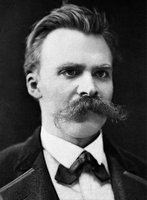
Kierkegaard was not alone. Friedrich Nietzsche (1844–1900), who never read him, announced that “God is dead” and asked how human beings might create their own values once the old ones had collapsed. Fyodor Dostoevsky put the question into fiction: Notes from Underground (1864) is arguably the first existentialist novel, and The Brothers Karamazov (1880) wrestles with the thought that if God does not exist, everything is permitted.
The German phase: Jaspers and Heidegger
“Existence” became a philosophical slogan in Germany after the First World War, when Kierkegaard was being translated and a generation that had watched Europe’s certainties collapse wanted a philosophy that spoke to its situation. Karl Jaspers (1883–1969), a psychiatrist turned philosopher, called his approach Existenzphilosophie and introduced the idea of limit situations (Grenzsituationen) – death, suffering, guilt, chance – in which the comfortable framework of everyday life breaks down and we are thrown back on ourselves.
The decisive book, however, was Martin Heidegger’s Being and Time (1927). Heidegger (1889–1976) insisted that his question was about Being, not about human beings, but the part of the book everyone read is its analysis of human existence, which he calls Dasein, “being-there.” Human beings are not thinking substances surveying the world from inside their heads; we are always already in a world, absorbed in tasks, surrounded by tools, caught up with others. We are “thrown” into a situation we did not choose – a body, a time, a language, a family – and we “project” ourselves towards possibilities. Mostly we do this in the mode of das Man, “the they”: we do what one does and think what one thinks. Anxiety and the anticipation of our own death can shake us out of this and make it possible to live authentically – the German eigentlich literally means “ownedly” – by taking over our thrown situation as our own.
Heidegger’s analysis supplied the whole vocabulary of later existentialism: thrownness, facticity, falling, anxiety, being-towards-death, authenticity, resoluteness. It also contains the sentence Sartre would turn into a slogan: “The essence of Dasein lies in its existence.” Yet when Sartre claimed him as an ally, Heidegger recoiled. In his Letter on Humanism (1947) he declared that his thinking had nothing to do with existentialism, and that Sartre had merely inverted a metaphysical formula while remaining stuck inside the metaphysics – above all, inside Descartes' picture of the self as a consciousness. We will come back to this.
The French phase: Sartre, Beauvoir, Camus
Existentialism as a public movement was born in occupied and then liberated Paris. Jean-Paul Sartre (1905–1980) had studied Husserl and Heidegger in Berlin in 1933, and during his months as a prisoner of war he read Heidegger intensively. The result was Being and Nothingness (1943), some 700 pages subtitled An Essay on Phenomenological Ontology.

Jean-Paul Sartre in 1950. Image: Wikimedia Commons.
Sartre divides reality into two kinds of being. Things – rocks, tables, paper-knives – are being-in-itself: solid, complete, simply what they are. Consciousness is being-for-itself: it is nothing in particular, a perpetual escape from any definition, and precisely for that reason free. I am never simply a coward or a waiter or a Frenchman the way a stone is a stone; I can always put a distance between myself and what I have been. This is why we are, in Sartre’s phrase, “condemned to be free”: we did not ask for freedom and cannot get rid of it, since even refusing to choose is a choice. Bad faith (mauvaise foi) is the attempt to pretend otherwise – to be a thing. Sartre’s famous example is the café waiter whose every movement is a little too precise and eager, who is playing at being a waiter so as not to face the fact that he is a free person who could walk out of the door. Other people complicate matters further: under “the look” of another, I am turned into an object, judged and fixed from outside, which is why Sartre’s play No Exit (1944) ends with the line “Hell is other people.”
In October 1945, at a packed and chaotic public lecture, Sartre defended all this against both Catholic and Communist critics. Existentialism Is a Humanism is short, vivid, the easiest way into Sartre – and also, by his own later admission, a simplification. In later decades he moved towards Marxism and became increasingly interested in how poverty, class and history limit the freedom he had once described as absolute.

Sartre’s discourse “Existentialism is a Humanism” can be broken down into five concepts: Existence precedes essence, Freedom, Responsibility, Anguish and Bad Faith.
Simone de Beauvoir (1908–1986), Sartre’s lifelong partner, is now recognised as a major existentialist thinker in her own right rather than his echo. The Ethics of Ambiguity (1947) is the ethical treatise Sartre never finished: it argues that freedom is always situated, that my freedom is bound up with the freedom of others, and that the human condition is an ambiguity between being a free subject and a vulnerable body in the world. The Second Sex (1949) applies existentialism to the lives of women. Its most famous sentence – “One is not born, but rather becomes, a woman” – is “existence precedes essence” turned into a tool of social analysis.
Albert Camus (1913–1960), born poor in French Algeria, is the writer most people meet first and the one who most firmly refused the label. His essay The Myth of Sisyphus (1942) opens with the claim that there is only one serious philosophical problem: whether life is worth living. Camus’s name for our situation is the absurd: the collision between the human demand for meaning and a universe that offers none. We cannot abolish the collision by faith – Camus explicitly accuses Kierkegaard and Jaspers of “philosophical suicide,” leaping into belief to escape it – nor by actual suicide, which merely removes one party to the conflict. The only honest response is revolt: to keep the absurd alive by living in full consciousness of it, without hope and without resignation. Sisyphus, condemned to roll his rock uphill forever, becomes the model: “One must imagine Sisyphus happy.”

Titian, Sisyphus (1548--49), Museo del Prado, Madrid. Image: Wikimedia Commons.
Camus’s later work, especially The Rebel (1951), turned this into a politics of limits and moderation, and his attack on revolutionary violence led to a bitter, permanent break with Sartre in 1952. Camus always insisted he was not an existentialist; he saw himself as a writer and moralist in the French tradition of Montaigne and Pascal. Whether he belongs in this article is a matter of definition. He belongs here because the question he asked is the existentialist question.
The French scene also had a religious wing. Gabriel Marcel, who coined the word, developed a Catholic existentialism of hope, fidelity and presence, and the broader religious tradition – the Protestant theologian Paul Tillich, the Jewish philosopher Martin Buber, the Russian Orthodox thinker Nikolai Berdyaev – reminds us that for the movement’s founder, and for many of its members, existentialism was a way of taking God more seriously, not less.

The writer and philosopher Albert Camus was known for his existentialist essays, novels, and love of football.
Is Sartre an existentialist at all?
This sounds like a trick question. Sartre is the one philosopher who embraced the label; if anyone is an existentialist, surely he is. Yet since Heidegger’s Letter on Humanism, a serious line of interpretation has argued that Sartre’s philosophy is in fact the very thing existentialism set out to overcome.
The most influential version of this argument comes from the American philosopher Hubert Dreyfus (1929–2017), whose Berkeley lectures on Kierkegaard and Heidegger shaped generations of students. Dreyfus’s claim is that the existentialist tradition, properly understood, is an attack on the picture of the self inherited from Descartes: a mind, transparent to itself, standing back from the world and deciding what to do. Kierkegaard attacked that picture by insisting that a self is not something you have but something you become through passionate commitment. Heidegger attacked it by showing that we are first of all absorbed in practical activity, and that detached reflection is a late and derivative achievement. Sartre, Dreyfus argued, read Being and Time through Husserlian spectacles and turned Dasein back into consciousness. His for-itself – a nothingness that is always aware of itself and can always detach itself from any role, value or commitment – is Descartes' thinking thing with a Parisian accent. On this reading, Sartre is not the culmination of existentialism but the last great Cartesian.
The deeper problem concerns freedom. For Sartre, every commitment I make is one I could revoke at the next instant, and to deny this is bad faith. Dreyfus and his collaborator Jane Rubin pointed out that this is precisely the position Kierkegaard diagnosed as the dead end of the ethical sphere: if everything is up for choice, including the standards by which I choose, then no commitment can get a grip on me, and my life becomes a series of revocable experiments that ends in the despair of meaninglessness. Kierkegaard’s answer was the unconditional commitment – to a person, a cause, a vocation, or God – that one does not so much choose as find oneself claimed by, and that defines what matters for the rest of one’s life. Such a commitment is risky; it can fail; it is the opposite of a safe, detached freedom. But on Dreyfus’s reading it is the whole point of existentialism: the self is constituted by what it cannot walk away from. For Sartre, such a commitment would itself be a case of bad faith. So the only self-declared existentialist ends up defending the very “unbounded freedom” that Kierkegaard identified as a form of despair.
Sartre has defenders. They point out that his later work takes situation, embodiment and history far more seriously; that Being and Nothingness itself contains a long analysis of the body and a theory of the “fundamental project” that gives a life its unity; and that Sartre’s account of consciousness, which denies any inner “I,” is less Cartesian than Dreyfus allows. The debate matters because it is really a debate about what existentialism is. If it is the philosophy of absolute self-creating freedom, Sartre is its hero. If it is the philosophy of a finite being who finds meaning by being claimed by something larger than its own choosing – a view shared, in different ways, by Kierkegaard, Heidegger, Marcel and Beauvoir – then Sartre is the brilliant exception rather than the rule.

Such examples point to the possibility of a non-ego-based ethics. They suggest that moral action does not require deliberation or even a sense of being a separate self.
After the café
As a Parisian fashion, existentialism was over by the early 1960s, displaced by structuralism and then by the thinkers we now call postmodern, several of whom – Foucault, Derrida – had grown up in its shadow and defined themselves against Sartre. But as a way of thinking it never went away.
In psychotherapy, Viktor Frankl’s Man’s Search for Meaning (1946), Rollo May’s work in the United States and Irvin Yalom’s Existential Psychotherapy (1980) built a whole tradition on the idea that anxiety, meaninglessness and the awareness of death are not disorders but conditions of being human. In theology, Tillich, Rudolf Bultmann and others reread Christianity in existentialist terms. In political thought, Frantz Fanon’s Black Skin, White Masks (1952) used Sartre’s analysis of the look to describe the experience of being seen as Black in a white world, and a tradition of Black existentialism runs from Richard Wright and Ralph Ellison to contemporary philosophers such as Lewis Gordon. Beauvoir’s work seeded existentialist feminism. Within academic philosophy, Dreyfus and Charles Taylor carried the Kierkegaard–Heidegger line into debates about authenticity, technology and the self, while a wave of recent books – Sarah Bakewell’s At the Existentialist Café (2016) is the best known – has brought the movement a new general readership.
Perhaps the surest sign of life is that the existentialist questions have become everybody’s questions. The pressure to “be yourself,” the anxiety of unlimited options, the suspicion that one is living a life designed by other people: a culture that worries about these things is still thinking with existentialist concepts, whether or not it knows their names.
Relevance to life
Existentialism was always meant to be lived, not merely studied. A few of its lessons:
You are not finished. The core existentialist claim – that no essence settles who you are – cuts both ways. It removes the comfort of “that’s just how I am,” but it also removes the sentence. Whatever you have been up to now, you are still choosing who you will be. Few ideas are more useful at a low point.
Watch for bad faith. Sartre’s waiter is a mirror. We all have roles we hide inside – the busy professional, the devoted parent, the person who “has no time” – and we all have moments when we let the role make our decisions for us. Noticing when you are playing at being something, rather than choosing it, is the beginning of honesty.
Anxiety is information. The existentialists refused to treat anxiety as simply a problem to be fixed. It is often the feeling of a real freedom you have not yet exercised, or a real question you have not yet faced. Before you try to switch it off, ask what it is telling you.
Beware the crowd. Kierkegaard’s “public” and Heidegger’s “they” were describing newspapers; we have feeds. The mechanism is the same: borrowing opinions, outrage and desires wholesale and mistaking them for one’s own. The existentialist discipline is to ask, regularly: do I actually think this?
Choose what you cannot take back. This is Dreyfus’s Kierkegaardian lesson, and the one a culture of keeping options open most needs. A life made entirely of revocable commitments – jobs, relationships, causes one could drop tomorrow – is a life in which nothing can matter very much. Meaning comes from the commitments that define you, and those are, by their nature, risky.
Face death to live. Heidegger’s being-towards-death and Camus’s lucid Sisyphus make the same point from opposite directions. Your time is finite and no one can live it for you. Keeping that in view does not darken life; it clarifies it, by making obvious what is worth doing and what is not.
Revolt, cheerfully. Camus’s final gift is the idea that one can look at a universe without guarantees and respond not with despair but with a kind of defiant joy – in work, in friendship, in sunlight, in football. Meaning is not found; it is made, and it is made in the doing.
◊ ◊ ◊
Where to start reading
- Sartre, Existentialism Is a Humanism (1945) – the one-hour manifesto. Read it first, then read the criticisms.
- Camus, The Myth of Sisyphus (1942) – especially the opening essay and the final pages on Sisyphus. Pair it with his novel The Stranger.
- Kierkegaard, Fear and Trembling (1843) – short, dramatic and strange; the best introduction to the religious root of the movement. The Present Age is even shorter and startlingly current.
- Beauvoir, The Ethics of Ambiguity (1947) – the most readable statement of existentialist ethics.
- Heidegger, Being and Time (1927) – not for beginners. Start with Division I, chapters 1–4, with Dreyfus’s Being-in-the-World (1991) beside you.
- Dostoevsky, Notes from Underground (1864) – existentialism before the name.
- Sarah Bakewell, At the Existentialist Café (2016) – a lively group biography that is also a genuinely good introduction to the ideas.
- Walter Kaufmann (ed.), Existentialism from Dostoevsky to Sartre – the classic anthology, still the most convenient way to sample the whole tradition.
Read more
- Existentialism – Stanford Encyclopedia of Philosophy. Thorough and up to date; good on the problem of defining the movement.
- Existentialism – Internet Encyclopedia of Philosophy. Organised around key themes; more approachable than the Stanford entry.
- Søren Kierkegaard – Stanford Encyclopedia of Philosophy.
- Jean-Paul Sartre – Stanford Encyclopedia of Philosophy.
- Albert Camus – Stanford Encyclopedia of Philosophy. Includes a careful discussion of whether Camus was an existentialist.
- Martin Heidegger – Stanford Encyclopedia of Philosophy.
- Kierkegaard and the Information Highway – Hubert Dreyfus, 1997 lecture. A short, readable statement of his reading of Kierkegaard on the spheres of existence, unconditional commitment and nihilism, which underlies his critique of Sartre.
- Existentialism – Philosophy Now. Anja Steinbauer’s brief, friendly introduction to a special issue on the movement.