Aristotle
The philosopher who wanted to understand everything
If Plato taught the West how to ask questions, Aristotle taught it how to organise the answers. He was the first thinker to divide knowledge into the disciplines we still recognise – logic, physics, biology, psychology, ethics, politics, rhetoric, literary theory – and to make serious, systematic contributions to every one of them. For nearly two thousand years, educated people in Europe and the Islamic world did not call him by name. They simply called him “the Philosopher.”

Who was Aristotle?
Aristotle (384 – 322 BCE) was born in Stagira, a small Greek town on the northern Aegean coast, in the shadow of the rising kingdom of Macedon. His father Nicomachus was court physician to the Macedonian king Amyntas III, and it is tempting to see in Aristotle’s lifelong fascination with living things the influence of a medical household. Both parents died while he was young, and he was brought up by a guardian, Proxenus of Atarneus.
At seventeen he was sent to Athens to study at Plato’s Academy. He stayed for about twenty years, first as a student and then as a teacher and researcher. He clearly admired Plato deeply, but he was never a disciple: the surviving works are full of respectful but unrelenting criticism of his teacher’s ideas. When Plato died in 347 BCE, the leadership of the Academy passed not to Aristotle but to Plato’s nephew Speusippus. Whether Aristotle was passed over or simply had other plans, he left Athens.
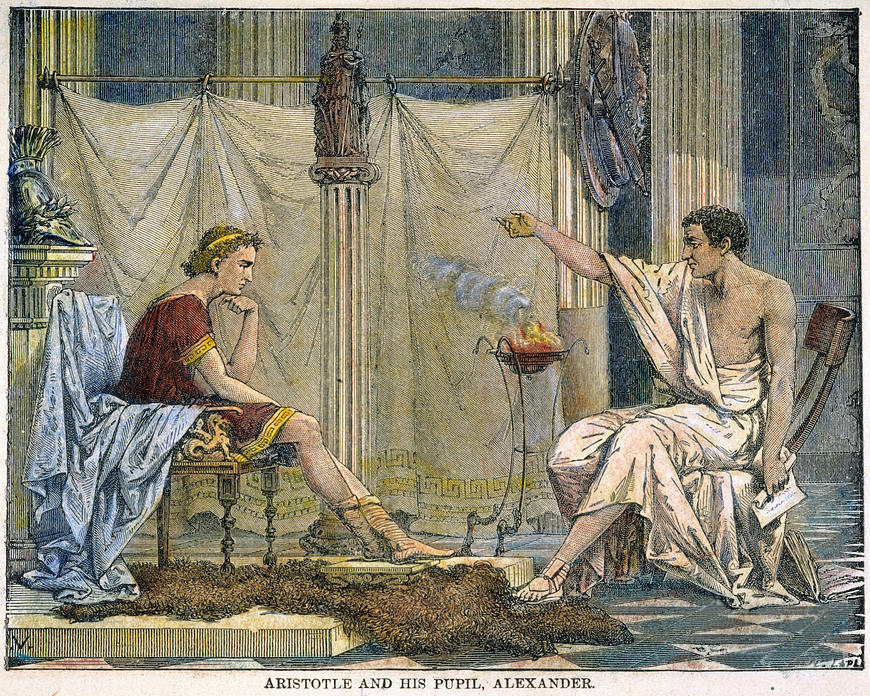
The next twelve years were wandering ones. He lived at Assos in Asia Minor at the court of the ruler Hermias, whose niece (or adopted daughter) Pythias he married. He then moved to the island of Lesbos, where he did much of the biological fieldwork – dissecting animals, observing marine life, classifying species – that fills his zoological writings. In 343 BCE, King Philip II of Macedon invited him to tutor his thirteen-year-old son, Alexander, the future Alexander the Great. How much the tutor influenced the conqueror is anyone’s guess; Alexander’s career of world domination is not obviously Aristotelian.
In 335 BCE Aristotle returned to Athens and founded his own school in a public gymnasium sacred to Apollo Lyceus: the Lyceum. His followers became known as the Peripatetics, possibly from the covered walkway (peripatos) where they met. The Lyceum was as much a research institute as a school. Aristotle and his students collected constitutions of Greek cities, records of dramatic performances, and biological specimens, and built up one of the ancient world’s first great libraries.
When Alexander died in 323 BCE, anti-Macedonian feeling flared in Athens, and Aristotle, with his Macedonian connections, was charged with impiety. Remembering the fate of Socrates, he withdrew to his mother’s family estate in Chalcis on the island of Euboea, reportedly remarking that he would not let Athens sin twice against philosophy. He died there a year later, aged sixty-two.

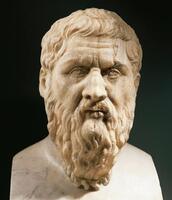
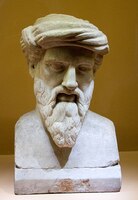
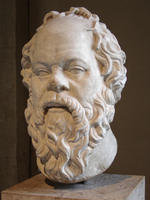
Aristotle, Roman marble copy of a Greek bronze by Lysippos. Image: Wikipedia.
The main works
Almost everything Aristotle wrote for publication has been lost. Ancient readers praised the beauty of his dialogues; we have none of them. What survives instead is around thirty treatises that were probably lecture notes or working texts for use within the Lyceum. They are dense, often abrupt, sometimes internally inconsistent, and quite unlike Plato’s polished conversations. Reading Aristotle is less like listening to a performance than like sitting in on a very demanding seminar.
The surviving works are traditionally grouped as follows:
Logic – Six works known collectively as the Organon (“the tool”): the Categories, On Interpretation, Prior Analytics, Posterior Analytics, Topics and Sophistical Refutations. Together they constitute the first systematic theory of reasoning in history.
Natural philosophy – The Physics, On the Heavens, On Generation and Corruption and Meteorology deal with change, motion, the elements and the cosmos. On the Soul (De Anima) is Aristotle’s psychology. The biological works – History of Animals, Parts of Animals, Generation of Animals and others – make up about a quarter of the entire surviving corpus.
Metaphysics – A collection of fourteen books on being, substance, causation and God. The title simply means “the works after the Physics” and was given by later editors.
Ethics and politics – The Nicomachean Ethics, probably his most widely read work today, and the Eudemian Ethics, a shorter parallel treatment. The Politics examines the city-state, its forms of government and the conditions of a good communal life.
Rhetoric and poetics – The Rhetoric is a systematic analysis of persuasion. The Poetics, which survives only in part, is the founding text of Western literary criticism.

Aristotle (384-322 BC), born in Stageira, Greece, is one of the most influential philosophers who ever lived. He worked not only in philosophy, but also wrote dozens of books on all topics, from astronomy and biology to literary theory.
The big ideas
Logic and the syllogism
Aristotle invented formal logic. His central discovery was the syllogism: an argument in which a conclusion follows necessarily from two premises purely because of its form. All humans are mortal; all Greeks are humans; therefore all Greeks are mortal. What matters is not the content but the structure – which is why the argument stays valid whatever we substitute for “Greeks,” “humans” and “mortal.” Aristotle catalogued which structures are valid and which are not. Kant, more than two thousand years later, thought that logic had been essentially complete since Aristotle. It was only in the late nineteenth century that logicians substantially went beyond him.
Nature and the four causes
Aristotle thought that to understand anything fully you have to answer four questions, which he called the four causes. What is it made of? (the material cause). What is its form or structure? (the formal cause). What brought it about? (the efficient cause). And what is it for? (the final cause). A statue is made of bronze, has the shape of a horse, was made by a sculptor, and exists to honour a general.
The most controversial of these is the final cause. Aristotle believed that nature itself is purposive: acorns grow in order to become oaks, teeth are sharp in order to cut. This teleology was rejected by the scientific revolution, but it survives, in a transformed way, in modern biology’s talk of the function of an organ or a gene.
Substance, form and matter
Where Plato located true reality in Forms beyond this world, Aristotle brought it firmly down to earth. What is fundamentally real, he argued, is not Beauty or Horse in the abstract but this horse, this person: individual substances. Each substance is a union of matter (what it is made of) and form (what makes it the kind of thing it is). A human being is not a soul trapped in a body; the soul simply is the form of a living body, the way that the shape of a statue is not something separate from the bronze. This view, called hylomorphism, is one of Aristotle’s most enduring ideas and has been revived in recent philosophy of mind.
Closely related is the distinction between potentiality and actuality. An acorn is potentially an oak; a child is potentially a mathematician. Change, for Aristotle, is the process by which potentials become actual – and reality as a whole is a vast unfolding of potentials towards their fulfilment.
Ethics: happiness and virtue
The Nicomachean Ethics begins with a simple question: what is the highest good for a human being? Aristotle’s answer is eudaimonia, usually translated as “happiness” but better rendered as “flourishing” or “living well.” Eudaimonia is not a feeling but an activity: a whole life lived in accordance with reason and excellence.
The way to such a life is through the virtues – courage, temperance, generosity, justice, honesty, good temper and the rest. A virtue, for Aristotle, is a settled disposition of character, acquired not by learning rules but by habit: we become brave by doing brave things, just as we become musicians by playing music. Each virtue is a mean between two vices: courage lies between cowardice and recklessness, generosity between meanness and extravagance. Finding the mean is not a matter of mechanical calculation but of practical wisdom (phronesis), the ability to see what a particular situation calls for.
Aristotle also gives the most influential ancient account of friendship, distinguishing friendships of utility, of pleasure and of virtue – and insisting that the last kind is essential to a happy life.
Politics: the political animal
“Man is by nature a political animal,” Aristotle writes at the start of the Politics. We are not self-sufficient individuals who happen to form societies; we are beings who can only become fully human within a community. The purpose of the city-state (polis) is not merely security or trade but the good life of its citizens. Aristotle surveyed the constitutions of the Greek world, classified them into monarchy, aristocracy and “polity,” and their corrupt forms of tyranny, oligarchy and democracy, and argued – unusually for his time – that a mixed constitution with a strong middle class was the most stable. The Politics also contains his notorious defence of slavery and his low estimate of women’s capacities, reminders that even the greatest minds are prisoners of their age.
Poetics: why we love tragedy
In the Poetics, Aristotle asks why we take pleasure in watching stories of suffering. His answer introduced two terms that literary critics still use: mimesis, the imitation or representation of human action, and catharsis, the purging or clarification of emotions such as pity and fear that a good tragedy produces. His analysis of plot, character and reversal is still taught in screenwriting courses.
Why Aristotle matters
For most of Western history, Aristotle was philosophy. After the fall of Rome his works were preserved and developed in the Islamic world by thinkers such as al-Farabi, Avicenna and above all Averroes, known in medieval Europe simply as “the Commentator.” Translated back into Latin in the twelfth and thirteenth centuries, Aristotle’s writings transformed European thought. Thomas Aquinas built Catholic theology on Aristotelian foundations, and Dante called him “the master of those who know.” The medieval university curriculum was essentially a course in Aristotle.
The scientific revolution of the seventeenth century defined itself largely against him. Galileo, Descartes and Newton overturned his physics and cosmology, and for a while “Aristotelian” became a term of abuse. Yet his biology remained impressive – Darwin remarked that Linnaeus and Cuvier had been his two gods, “but they were mere schoolboys to old Aristotle.” And in the twentieth century his ethics came roaring back. The revival of virtue ethics by philosophers such as Elizabeth Anscombe, Alasdair MacIntyre and Martha Nussbaum made the Nicomachean Ethics one of the most discussed texts in contemporary moral philosophy.
Above all, Aristotle bequeathed a temperament: patient, empirical, respectful of common sense and of what “the many and the wise” have said, willing to start from how things appear and work carefully towards how they are.
Relevance to life
Aristotle is, of all the ancient philosophers, perhaps the most immediately useful.
Happiness is an activity, not a mood. We tend to think of happiness as something that happens to us. Aristotle insists it is something we do: a life of engaged, excellent activity. This reframing alone can change how one approaches a career, a relationship or a difficult year.
Character is built by habit. You do not become patient by deciding to be patient. You become patient by acting patiently, again and again, until it becomes second nature. Aristotle’s insight anticipates a great deal of modern research on habit formation and is a corrective to the idea that good intentions are enough.
Look for the mean. Almost every virtue lies between an excess and a deficiency. When facing a decision, asking “What would be too much here, and what would be too little?” is a surprisingly practical guide.
Cultivate practical wisdom. Rules cannot cover every case. What good people have is not a better rulebook but a better eye – the ability to see what matters in this situation. That eye is developed through experience, reflection and attention to people who have it.
Choose your friends carefully. Aristotle’s distinction between friendships of utility, pleasure and virtue is a tool for taking stock of one’s own relationships. The friends who make us better are rare, and worth protecting.
We are political animals. Loneliness and isolation are not merely unpleasant; for Aristotle they are failures to be fully human. A flourishing life requires a community, and part of living well is contributing to one.
◊ ◊ ◊
Where to start reading
- Nicomachean Ethics – Books I, II and VIII–IX (on happiness, virtue and friendship) are the most accessible and rewarding.
- Politics, Book I – the famous opening on the political animal.
- Poetics – short, and the best introduction to Aristotle’s way of analysing a subject.
- Categories – if you want a taste of the logic without the technicality of the Analytics.
- Physics, Book II – the four causes and Aristotle’s defence of purpose in nature.
Good modern translations are available in the Hackett, Penguin Classics and Oxford World’s Classics series. The standard English edition of the complete works is The Complete Works of Aristotle: The Revised Oxford Translation, edited by Jonathan Barnes.
Read more
- Aristotle – Stanford Encyclopedia of Philosophy. A thorough, scholarly overview of his life and thought.
- Aristotle’s Ethics – Stanford Encyclopedia of Philosophy. A detailed guide to the Nicomachean Ethics.
- Aristotle – Internet Encyclopedia of Philosophy. Somewhat more approachable than the Stanford entry.
- Aristotle’s works – The Internet Classics Archive (MIT). Free full texts in older but readable English translations.