Democritus
The laughing philosopher who built the world out of atoms and void
Around 420 BCE, a well-travelled man from a provincial Greek town arrived in Athens, the intellectual capital of the world. He had spent his inheritance seeing Egypt, Persia and perhaps further east. He had thought harder about the structure of matter than anyone alive. He was, by his own account, entirely unnoticed. “I came to Athens,” he later wrote, “and no one knew me.”
The man was Democritus of Abdera, and Athens' indifference set the pattern for his afterlife. Plato, who wrote about almost every thinker of the age, never mentions him once. His seventy-odd books have all been lost. And yet he proposed, in the fifth century BCE, the single most successful idea in the history of physical science: that the world is made of atoms.
Life
Democritus was born around 460 BCE in Abdera, a prosperous city on the Thracian coast, in what is now north-eastern Greece. This makes him roughly ten years younger than Socrates – a contemporary, not a “Presocratic” in the strict sense, though he is always grouped with them because his questions were theirs. Abdera was a byword for stupidity in Greek jokes, which is odd, since it produced both Democritus and Protagoras, the greatest of the sophists.
Almost everything we know about his life comes from Diogenes Laertius, writing seven centuries later, and much of it is anecdote. He was said to be wealthy, to have squandered his fortune on travel – Egypt to learn geometry from the priests, Persia to learn from the Magi, possibly India and Ethiopia – and to have returned so poor that his brother had to support him. He is supposed to have redeemed himself by reading his greatest work aloud to the citizens, who rewarded him with money and statues. He is said to have lived to ninety, or a hundred, or a hundred and nine, and to have died by deliberately fasting, delaying the end for three days by inhaling the smell of warm bread so that his sister could celebrate a festival undisturbed.
Some of these stories are certainly false. The tradition that he blinded himself to stop the senses distracting his intellect is contradicted by the many reports of his careful observation. The famous tale in which the citizens of Abdera, alarmed by his constant laughter, send for the physician Hippocrates to cure his madness – and Hippocrates, after conversation, pronounces him the only sane man in the city – comes from a set of letters forged centuries after both men were dead. But the stories tell us how the ancient world saw him: as a polymath, a wanderer, and a man amused by human folly.
What is solid is this. Democritus was the pupil of Leucippus of Miletus, a shadowy figure who seems to have originated atomism and whose existence Epicurus later denied. Ancient writers found it impossible to separate the contributions of master and pupil, and modern scholars have not done better; we usually speak of “the atomists” and credit the developed theory to Democritus, who wrote the books. Thrasyllus, an astrologer at the court of Tiberius, catalogued them in tetralogies as he did Plato’s: works on ethics, physics, mathematics, music, literature and technical subjects – some sixty or seventy titles, including The Great World-System, The Little World-System, On the Mind, On the Senses, On Colours, On Cheerfulness, and a treatise on the cone.
Not one survives. We have around three hundred fragments, but the vast majority are short ethical maxims of uncertain authenticity, preserved in later anthologies. For the physics, which is what made him famous, we depend almost entirely on Aristotle and his commentators – hostile witnesses who nevertheless took him seriously enough to report him accurately.

The problem he inherited
To see why atomism was needed, you have to see what came before it.
A generation earlier, Parmenides of Elea had produced an argument that seemed to make the whole physical world impossible. What is, is; what is not, is not. You cannot think or speak about what is not, since there is nothing there to think about. But change requires something coming to be from what it was not, and motion requires empty space – which is to say, a place where there is nothing. Therefore change and motion are illusions. Reality is one, unchanging, undivided and full. Parmenides' followers Zeno and Melissus tightened the screws with paradoxes designed to show that plurality and motion were logically incoherent.
Nobody believed the conclusion. Everybody could see things move. But nobody could find the flaw in the argument, and the philosophers of the next generation – Empedocles, Anaxagoras, the atomists – all built their systems as attempts to save the appearances while respecting Parmenides' logic.
The atomists' solution was the most audacious. Parmenides had said there could be no what-is-not. Leucippus and Democritus simply denied it. There is what-is: matter. And there is what-is-not: the void, empty space. Both exist. “What is,” Democritus said in a phrase Aristotle found paradoxical, “is no more than what is not.” Once you admit the void, motion is possible – things move into empty space – and once you admit that matter comes in many pieces rather than one, plurality is possible too.
But Democritus kept the Parmenidean insight where it mattered. Melissus had argued that if there were many things, each would have to be like Parmenides' One: uncreated, indestructible, unchanging, indivisible. Democritus agreed. His atoms are exactly that – an infinite number of little Parmenidean beings, each eternal and unalterable, scattered through an infinite void.
Atoms and void
The word atomos means “uncuttable.” An atom is a piece of matter so small and so solid that it cannot be divided, because it contains no void – and only void, on this theory, allows a thing to be split. Atoms are infinite in number and infinitely varied in shape: some are hooked, some smooth, some rough, some round. They differ in size and in arrangement, but not in substance. There is only one kind of stuff; the diversity of the world comes from the geometry of its parts.
Atoms have always been in motion, colliding, rebounding, and where their shapes allow, catching on one another and clumping together. Everything we see – water, iron, fire, flesh – is a temporary tangle of atoms. When the tangle forms, a thing “comes to be”; when it disperses, the thing “perishes.” But nothing really comes to be or perishes, because the atoms themselves never change. Democritus compared the process to letters: the same few characters, arranged differently, spell a tragedy or a comedy. Change is rearrangement, nothing more.
From this he drew consequences of breathtaking scope. Since atoms and void are infinite, worlds form wherever enough atoms swirl together – there are infinitely many worlds, some with suns and moons, some without, some growing, some dying, some colliding with each other. Our world is one among countless others and has no special status. Life arose from moisture and warmth by natural processes. The soul is made of atoms too – exceptionally fine, spherical, fiery ones, which move most easily and so can move the body. At death they scatter. There is no afterlife, and the gods, if they exist, are themselves atomic compounds, perhaps large and long-lived images that drift through the air and appear to us in dreams.

Appearance and reality
The most philosophically explosive part of the theory concerns the senses. Atoms have shape, size, arrangement and motion – and nothing else. They have no colour, no taste, no temperature, no smell. Yet the world we experience is full of these. Where do they come from?
Democritus' answer was that they are produced in us by the interaction of atoms with our sense organs. Sweetness is the effect of smooth, round atoms on the tongue; bitterness of jagged ones; colour arises from the arrangement and position of atoms at a thing’s surface and the way they affect the eye. Vision itself works by eidola – thin films of atoms continuously peeling off the surfaces of objects and striking the eye. The qualities we experience are real as experiences, but they are not in the objects. In the objects there are only atoms and void.
This is the first appearance in Western thought of what would later be called the distinction between primary and secondary qualities – the idea that shape and motion belong to things themselves while colour and taste belong to our perception of them. Galileo, Descartes, Locke and Newton all took it up, and it remains the default picture in physics. Democritus stated it in one sentence: “By convention sweet, by convention bitter, by convention hot, by convention cold, by convention colour; in reality atoms and void.”
He saw the difficulty this created. If the senses do not show us the world as it is, how do we know anything – including the atomic theory, which was, after all, inferred from what the senses show? Democritus distinguished two kinds of knowledge: the “bastard” knowledge of sight, hearing, smell, taste and touch, and the “legitimate” knowledge of the intellect, which takes over “when the bastard kind can no longer see or hear or smell or taste or perceive by touch anything smaller.” But he knew the intellect depended on the senses for its material, and in one of the most remarkable fragments in Greek philosophy he has the senses answer back: “Wretched mind, do you take your evidence from us and then throw us down? Our overthrow will be your fall.”
He never resolved the tension. Neither has anyone since. Every scientific theory that explains the appearances by positing an unobservable reality faces exactly this problem, and Democritus was the first to face it.
Necessity, not purpose
Why do atoms move? Democritus said they always have. Aristotle complained that this was no answer, and for two thousand years philosophers agreed. But Democritus was making a deliberate choice. He did not want an explanation that appealed to purpose – to a designing mind, a cosmic intelligence, a reason why the world is as it is. Everything happens, he said, “by necessity”: each collision is caused by a prior collision, back without limit. There is no plan.
Aristotle found this the most objectionable part of the theory. The universe, for Aristotle, is shot through with purpose: things happen for the sake of ends, and nature does nothing in vain. Democritus' world has no ends at all, only mechanism, and Aristotle accused him of attributing everything to chance. Democritus would have denied the charge. In his view nothing happens by chance; it is just that the causes are blind. The distinction – between a world governed by law and a world governed by intention – is one that modern science made in Democritus' favour, though it took until the seventeenth century to do so.
How to live in a world of atoms
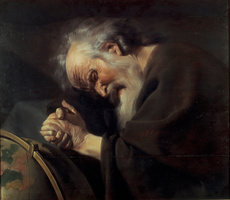
The Roman world remembered Democritus as the laughing philosopher, paired with weeping Heraclitus: one laughed at human folly, the other wept at it. Juvenal and Seneca both use the image, and Renaissance painters loved it. Whether the historical Democritus laughed more than most is unknowable, but the tradition preserves something true about his ethics, which are cheerful in a way that his physics might not lead one to expect.
The goal of life, he taught, is euthymia – literally “good spirits” – a settled contentment or cheerfulness. He wrote a book with that title, and Seneca’s On Tranquillity of Mind is in part a response to it. Euthymia comes from moderation: from not overreaching, not envying, not desiring what you cannot have. “Cheerfulness comes to people through moderation of enjoyment and a balanced life. Deficiency and excess tend to turn into their opposites and produce great disturbances in the soul.” The person who wants little is rich; the one who wants everything is poor whatever he owns.
Democritus also insisted that goodness must be internal. It is not enough to avoid wrongdoing out of fear; one should “feel shame before oneself” more than before others, and “not do anything base whether or not anyone will know.” This is one of the earliest statements in Greek thought of conscience as an inner tribunal, and it anticipates a great deal of later moral philosophy.
None of this depends on gods or an afterlife, which is consistent: if the soul scatters at death, ethics must be about this life. Epicurus, who inherited the atomic physics, also inherited this move, and his school made “do not fear death, since after it there is nothing to fear” into a way of life.

Mathematics and other curiosities
Democritus' range was extraordinary even by the standards of an age that had not yet divided knowledge into disciplines. Archimedes credits him with discovering that a cone has one-third the volume of a cylinder with the same base and height, though the rigorous proof came later from Eudoxus. He posed a puzzle that goes to the heart of the atomic theory: if you slice a cone parallel to its base, are the two adjacent surfaces equal or unequal? If equal, the cone is really a cylinder; if unequal, its surface is stepped rather than smooth. The puzzle is about whether magnitude is infinitely divisible, and it was still being discussed when the calculus was invented.
He wrote on the growth of embryos, the origin of human society (which he seems to have traced to need and imitation rather than divine gift), the causes of disease, the nature of magnets, and the technique of painting. Almost all of it is gone. Enough survives to show a mind that took the entire world as its subject and expected every part of it to be explicable in the same terms.
What happened to his ideas
Plato ignored him, and Diogenes Laertius reports a story that he wanted to burn Democritus' books and was talked out of it by two Pythagoreans, who pointed out that the books were already too widely circulated. Whether or not that is true, the Timaeus, Plato’s account of the physical world, reads in places like an answer to atomism – geometrical particles, yes, but arranged by a divine craftsman for the best.
Aristotle took him seriously, wrote a lost book about him, and refuted him at length. Aristotle’s arguments – that the void is impossible, that matter is continuous, that nature acts for ends – became orthodoxy for eighteen hundred years, and atomism survived only as a minority tradition.
That tradition was kept alive by Epicurus, who adopted Democritus' physics around 300 BCE with two modifications: he gave atoms weight, so they fall through the void, and he gave them an unpredictable “swerve,” to allow for free will in a mechanical universe. Epicurus' Roman follower Lucretius set the whole system out in a Latin poem, On the Nature of Things, which survived the Middle Ages in a handful of manuscripts and was rediscovered in 1417. Through Lucretius, atomism reached Gassendi, Boyle and Newton in the seventeenth century, and became the working assumption of chemistry when John Dalton published his atomic theory in 1808.
Modern atoms are not Democritus' atoms. Ours are divisible into protons, neutrons and electrons, which are themselves made of quarks; they are mostly empty space; they behave in ways that would have astonished any Greek. But the structure of the explanation – a small number of fundamental particles, differing in a few properties, combining according to law to produce the whole variety of observable things – is his. When Richard Feynman was asked what single sentence he would pass on to a future civilisation if all scientific knowledge were destroyed, he chose the atomic hypothesis. Democritus got there first, with no instruments, by argument alone.
Why he matters
Democritus is the ancestor of a whole way of thinking, and the questions his theory raises are the questions that way of thinking still cannot escape.
Reductionism. If everything is atoms and void, then chemistry is physics, biology is chemistry, and psychology is biology. That programme has been spectacularly successful and remains incomplete. Whether the mind, in particular, can be fully explained in terms of its physical parts is the central unresolved problem in the philosophy of mind, and Democritus stated both sides of it: the mind that reduces the senses to atoms, and the senses that warn the mind it is undermining itself.
The status of experience. The claim that colour, taste and warmth are not in the world but in us has become common sense in science and remains deeply puzzling in philosophy. If they are not in the world, where are they? What kind of thing is a sensation? Every theory of consciousness is an attempt to answer a question Democritus asked.
Purpose. A world of atoms moving by necessity has no purpose built into it. For some this is liberating – it means nothing is fated, nothing owed to the gods, and meaning is ours to make. For others it is the abolition of meaning altogether. The debate between these responses runs from Epicurus through Lucretius, Spinoza and Nietzsche – who admired Democritus above all the Greeks – to the present.
How to live. Democritus is proof that a thoroughly materialist picture of the universe does not have to issue in gloom. His ethics of contentment, moderation and inner integrity was worked out in full knowledge that the soul is mortal and the cosmos indifferent, and it is one of the most attractive things in ancient philosophy. The laughing philosopher laughed, the tradition suggests, not because the world is absurd, but because he had understood it and found he could still be cheerful.
◊ ◊ ◊
Where to start reading
- C. C. W. Taylor, The Atomists: Leucippus and Democritus. Fragments, a Text and Translation with a Commentary (University of Toronto Press, 1999) – the standard English edition of everything that survives, with a lucid commentary. Expensive, but the one book to have.
- Paul Cartledge, Democritus (Routledge, 1998) – a short, readable introduction in the Great Philosophers series, good on the historical context.
- G. S. Kirk, J. E. Raven and M. Schofield, The Presocratic Philosophers (Cambridge, 2nd ed. 1983) – the classic survey, with Greek texts, translations and discussion; the chapter on the atomists is excellent.
- Jonathan Barnes, The Presocratic Philosophers (Routledge, 1982) – philosophically the most demanding of the surveys and the most rewarding; Barnes takes the atomists' arguments apart in detail.
- James Warren, Presocratics (Acumen, 2007) – a more recent and more compact introduction to the whole period.
- André Laks and Glenn W. Most (eds.), Early Greek Philosophy, Volume VII: Later Ionian and Athenian Thinkers, Part 2 (Loeb Classical Library, 2016) – the atomists in the new Loeb edition, with Greek and English on facing pages.
- Lucretius, On the Nature of Things, translated by A. E. Stallings (Penguin, 2007) – the great Roman poem in which Democritus' physics, as revised by Epicurus, reaches its fullest surviving expression. A verse translation that is a pleasure to read.
Read more
- Democritus – Stanford Encyclopedia of Philosophy. Sylvia Berryman’s authoritative survey of the sources, the physics, the epistemology and the ethics.
- Leucippus – Stanford Encyclopedia of Philosophy. What can be said about the shadowy founder of atomism.
- Ancient Atomism – Stanford Encyclopedia of Philosophy. Atomism from Democritus through Epicurus to the Indian and medieval traditions.
- Democritus – Internet Encyclopedia of Philosophy. A shorter and more approachable account.
- Presocratic Philosophy – Stanford Encyclopedia of Philosophy. The wider context in which atomism arose.
- Parmenides – Stanford Encyclopedia of Philosophy. The argument against change and plurality that atomism was designed to answer.
- Epicurus – Stanford Encyclopedia of Philosophy. The philosopher who took over and modified Democritus' system.
- Lucretius – Stanford Encyclopedia of Philosophy. The poem through which atomism reached the modern world.