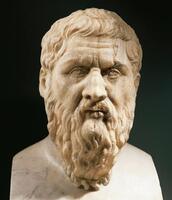
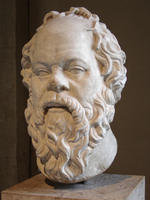
Pythagoras
The philosopher who heard numbers in the world
Everyone knows one thing about Pythagoras: the theorem about the square on the hypotenuse. It is almost certainly the one thing he did not do. The Babylonians knew the theorem a thousand years before he was born, and there is no reliable evidence that he ever proved it. What Pythagoras actually was is stranger and more interesting: a charismatic religious teacher who founded a community with strict rules of life, taught that souls are reborn in new bodies, and – somewhere along the way – planted the idea that the deepest truth about the world is numerical. That idea would shape Plato, drive the scientific revolution, and still underlies every physics equation written today.

Who was Pythagoras?
Pythagoras (c. 570 – c. 495 BCE) was born on Samos, a prosperous island off the coast of what is now Turkey, at the eastern edge of the Greek world. His father Mnesarchus is variously described as a gem-engraver or a merchant. Samos was only a short sail from Miletus, where Thales and Anaximander were inventing natural philosophy, and later tradition makes Pythagoras a student of one or both. Tradition also sends him travelling to Egypt, Babylon and even further afield to learn the wisdom of the East. Some of this may be true; most of it is the kind of story the Greeks told about every sage.
Around 530 BCE, when Samos had fallen under the tyranny of Polycrates, Pythagoras left. He settled at Croton, a Greek colony on the southern coast of Italy, and there he did something no Greek thinker had done before: he founded a community. His followers lived by a shared code, held property in common (according to some accounts), observed rules about food, dress and behaviour, and kept certain teachings secret. The community was at once a religious brotherhood, a school and a political faction. Women were admitted, which was remarkable for the time; Pythagoras' wife Theano and daughters are named among its members.
The Pythagoreans rapidly gained influence in the politics of Croton and neighbouring cities, and that influence made them enemies. At some point – perhaps around 510 BCE, perhaps later – an uprising led by a rejected applicant named Cylon drove them out. Pythagoras fled to Metapontum, where he died. The community survived him for several generations, though it was violently attacked again in the mid-fifth century, and its members scattered across the Greek world.
Already in his lifetime Pythagoras had a reputation as something more than a man. Stories circulated that he had a golden thigh, that he had been seen in two cities at once, that a river had greeted him by name. Aristotle, who was not given to credulity, records some of these tales, which suggests they were well established within a century and a half of his death.

The problem of the sources
Pythagoras, like Socrates, wrote nothing. Unlike Socrates, he had no Plato. The earliest references to him – from his near-contemporaries Xenophanes and Heraclitus, and from the historian Herodotus – are brief and not always flattering. Heraclitus called him “the chief of swindlers.” The first Pythagorean whose writings survive in fragments is Philolaus (c. 470 – c. 385 BCE), born around the time Pythagoras died. The great biographies by Diogenes Laertius, Porphyry and Iamblichus were written seven or eight hundred years after the fact, and they are full of miracles and pious invention.
To make matters worse, the Pythagorean tradition had a habit of attributing every discovery made by any member to the founder. Later Pythagoreans and Platonists then read their own sophisticated mathematics and metaphysics back into Pythagoras himself. By the Roman period he had become the source of essentially all Greek philosophy and science.
Modern scholarship, especially since Walter Burkert’s groundbreaking Lore and Science in Ancient Pythagoreanism (1962), has stripped much of this away. The Pythagoras who emerges from the earliest evidence is not a mathematician but a religious teacher and wonder-worker who taught a way of life. The mathematics and cosmology belong mainly to later Pythagoreans such as Philolaus and Archytas. Not every scholar accepts every step of this deflation, but the broad picture is now widely shared. What follows tries to distinguish what Pythagoras probably taught from what the Pythagorean tradition later made of it.
Who was Plato, what did he write, and why does a thinker who died almost 2,400 years ago still shape how we think about knowledge, justice, love and the good life?
The big ideas
The transmigration of souls
The best-attested doctrine of Pythagoras himself is metempsychosis: the belief that the soul is immortal and passes at death into another body, human or animal. Xenophanes, writing while Pythagoras was still alive or shortly after, tells the story of Pythagoras seeing a puppy being beaten and crying out: “Stop! Do not beat it – that is the soul of a friend of mine; I recognised his voice.” The story is meant as mockery, but it confirms that this was what Pythagoras was known for.
Pythagoras was said to remember his own previous lives, and later Pythagoreans held that the soul’s fate in its next life depended on how it had lived in this one. This gave the Pythagorean way of life its urgency. It also gave the Pythagoreans a reason for their much-discussed dietary rules. If the soul of a person may now inhabit an animal, then eating meat becomes a form of cannibalism. Whether Pythagoras was a strict vegetarian is disputed – some sources say he only avoided certain animals – but the tradition was strong enough that until the nineteenth century a meat-free diet was called a “Pythagorean diet.”
The Pythagorean way of life
Pythagoras did not, as far as we know, offer a theory of the world. He offered a bios, a way of living. The community’s rules were preserved in short sayings called akousmata (“things heard”) or symbola. Some were dietary: do not eat beans. Some were ritual: do not poke a fire with a knife; put on the right shoe first. Some were ethical: do not pursue your own advantage; friends have all things in common. Many are puzzling, and the Pythagoreans themselves seem to have disagreed about whether to take them literally or allegorically.
Some practices were more clearly philosophical. New members were said to observe a long period of silence. Members were expected each evening to review the day, asking themselves what they had done, where they had gone wrong and what they had left undone – one of the earliest recorded practices of systematic self-examination. And they were expected to observe strict loyalty to one another, giving rise to the Greek proverb that “friends have all things in common.” The friendship of the Pythagoreans Damon and Phintias, one of whom offered his own life as surety for the other, became a byword for loyalty in the ancient world.
Number and harmony
The most famous Pythagorean idea is summed up in Aristotle’s report that the Pythagoreans held that “things are numbers,” or that the principles of number are the principles of everything. Whether Pythagoras himself said anything of the kind is uncertain. But something in the early community set the tradition on this path, and the most plausible candidate is music.
The Pythagoreans discovered – or at least were the first Greeks to make philosophical use of the discovery – that the basic musical concords correspond to simple numerical ratios. A string exactly half the length of another sounds an octave above it (2:1); two-thirds the length gives the fifth (3:2); three-quarters gives the fourth (4:3). This is a genuinely remarkable fact. Something as apparently ineffable as musical harmony turns out to be governed by the first four whole numbers. The Pythagoreans made much of these four numbers, which add up to ten, arranged in a triangle they called the tetractys and which they swore oaths by.
From here it was a short step to the idea that the whole cosmos is ordered by number and proportion – that it is, in a literal sense, a harmony. The Pythagoreans held that the heavenly bodies, moving at different speeds, produce a music that we cannot hear only because it has been in our ears since birth: the harmony of the spheres. This idea would echo through Plato, Boethius, Dante and Kepler.
Philolaus and the Pythagorean cosmos
The first Pythagorean philosophy we can actually read is that of Philolaus, and it is a serious piece of thinking. Philolaus held that the world is composed of two kinds of principle: unlimiteds (like continuous stuff, or space, or time) and limiters (shapes, boundaries, structures), held together by harmonia. Number is what makes things knowable: we understand a thing when we grasp the proportion or structure that limits it. This is the root of the idea that intelligibility and mathematical structure go together.
Philolaus also proposed the first cosmology to remove the earth from the centre of the universe. In his system the earth, the moon, the sun, the planets and the fixed stars all revolve around a central fire, with a “counter-earth” on the far side that we never see. It is not heliocentrism – the sun is not at the centre – but it was bold enough that Copernicus cited it two thousand years later as an ancient precedent for moving the earth.
Mathematics proper
Later Pythagoreans certainly did real mathematics. They studied the properties of odd and even numbers, figurate numbers (square, triangular, oblong), and the theory of means and proportions. Archytas of Tarentum, a friend of Plato, solved the problem of doubling the cube and worked out mathematical harmonics in detail. The famous theorem was probably known to and perhaps proved by some member of the school, even if not by Pythagoras himself.
The most intriguing story is that of the irrationals. If you take a square whose side is 1, its diagonal is the square root of 2, which cannot be expressed as a ratio of whole numbers. For a school that believed reality was built from whole-number ratios, this was a crisis. Legend has it that the Pythagorean Hippasus, who revealed the secret, was drowned at sea for his trouble. The story is almost certainly not true, but it captures something real: the Pythagoreans discovered that the world is mathematical, and then discovered that mathematics is stranger than they had hoped.
Why Pythagoras matters
Pythagoras' influence runs through Western thought along two channels, and they often flow together.
The first is Plato. Plato visited the Pythagorean communities of southern Italy, befriended Archytas, and absorbed from them the doctrine of the immortal soul, the practice of philosophy as a way of life, and above all the conviction that reality is mathematical and that mathematics is the training ground for the mind. The Timaeus, Plato’s account of the cosmos, is thoroughly Pythagorean; the Republic requires the future philosopher-rulers to study ten years of mathematics. Through Plato, Pythagoreanism entered the mainstream of philosophy and never left.
The second is science. When Copernicus, Kepler and Galileo overthrew Aristotle’s cosmos, they did so under a Pythagorean banner. Kepler’s Harmony of the World (1619) is an explicit attempt to find the musical ratios in the orbits of the planets – and in the course of it he discovered his third law of planetary motion. Galileo’s famous remark that the book of nature is “written in the language of mathematics” is a Pythagorean creed. Modern physics, with its assumption that the universe is fundamentally describable by equations, is Pythagoreanism carried out with unprecedented success. The physicist Eugene Wigner’s puzzle about “the unreasonable effectiveness of mathematics” in the natural sciences is the Pythagorean question asked afresh.
Alongside these there is a third, more shadowy legacy. Pythagoras became the patron of every esoteric tradition that claimed hidden knowledge: Neopythagoreanism in the Roman world, Renaissance number mysticism, Freemasonry, numerology. The line between the Pythagoras who inspired Kepler and the Pythagoras who inspired the occultists has never been entirely clear – which is perhaps fitting, since it was not entirely clear in the original community either.

Relevance to life
Pythagoras is remote from us in a way that Socrates or Aristotle are not. And yet several of his concerns turn out to be strikingly current.
Philosophy as a way of life, not a set of opinions. The Pythagoreans were the first to see that a philosophy has to be lived – that it involves what you eat, how you treat your friends, how you spend your evenings. Much modern interest in Stoicism, Buddhism and other practical philosophies is a rediscovery of this Pythagorean insight: that ideas about the good life are worthless unless they shape a daily practice.
Examine the day. The Pythagorean evening review – what did I do, where did I fail, what did I leave undone? – is one of the oldest self-improvement techniques on record. It reappears in the Stoics, in Christian examination of conscience, and in every modern journal-keeping habit. It costs five minutes and it works.
Kinship with living things. Whatever one thinks of reincarnation, the Pythagorean conclusion – that animals are not mere things but beings with whom we share something essential – is now a mainstream ethical position. The modern debate about vegetarianism and animal welfare began, in the West, at Croton.
The world is more ordered than it looks. The Pythagorean discovery that musical harmony is arithmetic is a model for a certain kind of intellectual hope: that behind confusing appearances there is a structure that the mind can grasp. That hope built modern science. It is also, on a personal level, a reasonable attitude towards problems that seem chaotic – look for the ratio.
Beware the charismatic community. The Pythagorean brotherhood shows both the power and the danger of a closed group organised around a revered leader and secret teachings. It produced real friendship and real discoveries. It also produced hero-worship, political overreach and, in the end, violent backlash. Anyone tempted by a movement that promises transformation through loyalty and secrecy might reflect on how the Pythagoreans ended.
Check the attribution. Almost everything “everyone knows” about Pythagoras is wrong, because for two thousand years people attributed to a famous name what they wanted to be true. It is a standing reminder to ask where a claim actually comes from.
◊ ◊ ◊
Where to start reading
There are no writings by Pythagoras to read. The best entry points are:
- The fragments of Philolaus – the earliest Pythagorean philosophy we possess, in Carl Huffman’s Philolaus of Croton: Pythagorean and Presocratic (Cambridge, 1993), which includes translation and commentary.
- Diogenes Laertius, Lives of the Eminent Philosophers, Book VIII – the ancient biography, short, gossipy, and a good example of how the legend grew. Available in Pamela Mensch’s translation (Oxford, 2018) and free online.
- Iamblichus, On the Pythagorean Way of Life – the fullest ancient account of the community and its rules, late and credulous but fascinating. Translated by Gillian Clark (Liverpool, 1989) or John Dillon and Jackson Hershbell (Scholars Press, 1991).
- Plato, Timaeus – to see what Pythagoreanism became in the hands of a great philosopher.
- Walter Burkert, Lore and Science in Ancient Pythagoreanism (Harvard, 1972) – the scholarly landmark, demanding but essential for anyone who wants to know how we know what we know.
- Christoph Riedweg, Pythagoras: His Life, Teaching, and Influence (Cornell, 2005) – the most accessible reliable modern introduction.
Read more
- Pythagoras – Stanford Encyclopedia of Philosophy. Carl Huffman’s authoritative account of what can and cannot be known about the man.
- Pythagoreanism – Stanford Encyclopedia of Philosophy. The wider tradition, from Philolaus to the Neopythagoreans.
- Philolaus – Stanford Encyclopedia of Philosophy. The first Pythagorean whose ideas we can actually reconstruct.
- Pythagoras – Internet Encyclopedia of Philosophy. A more approachable overview.
- Pythagoras of Samos – MacTutor History of Mathematics Archive, University of St Andrews. Good on the mathematical side of the tradition.
- Diogenes Laertius, Life of Pythagoras – Perseus Digital Library. Free full text of the ancient biography.