Heraclitus
The philosopher of fire, flux and the hidden harmony of opposites
“You cannot step into the same river twice.” Almost everyone has heard the line, and almost everyone takes it to mean that Heraclitus believed nothing stays the same. But what he actually wrote is more interesting: “On those who step into the same rivers, different and different waters flow.” The river is the same river. That is the whole point. It stays the same precisely because the water keeps changing. A river with still water would be a pond. Heraclitus was not the philosopher of chaos that his reputation suggests. He was the philosopher of the order that lives inside change – and of the difficult, paradoxical truth that stability and flux are not enemies but partners.

Who was Heraclitus?
Heraclitus (c. 540 – c. 480 BCE) was born in Ephesus, a wealthy Greek city on the coast of Asia Minor, not far from Miletus, where Thales, Anaximander and Anaximenes had recently begun the Greek project of explaining the world without recourse to the gods. He was from an aristocratic family – the ancient biographers say he was in line to hold the hereditary title of “king,” a largely ceremonial priestly office, and passed it on to his brother. He apparently wanted nothing to do with the political life of his city. When the Ephesians asked him to write them laws, he refused, saying the city was already too far gone; he preferred, one story says, to play knucklebones with the children in the temple of Artemis.
He was, by every account, difficult. He despised the common run of people (“most men are bad”) and had no more respect for the famous. Homer, he said, deserved to be thrown out of the competitions and beaten; Hesiod, “the teacher of most men,” did not even know that day and night are one; Pythagoras was “the chief of swindlers.” He seems to have had no teacher and founded no school. “I searched myself,” he said.
He wrote one book, deposited it in the temple of Artemis, and – according to a tradition that may be partly legend – wrote it deliberately obscurely so that only the capable could understand it. Antiquity called him “the Obscure” and “the Riddler.” Socrates, in a story told by Diogenes Laertius, was given the book to read and remarked: “What I understood was fine, and I dare say what I did not understand was fine too; but it needs a Delian diver to get to the bottom of it.”
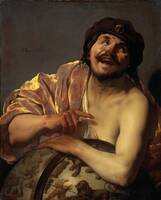
The stories of his death are colourful and unreliable. He is said to have contracted dropsy, tried to cure himself by burying himself in cow dung, and died there – perhaps eaten by dogs. The tales are probably malicious inventions built out of his own sayings about wet and dry souls. But they tell us how he was remembered: as a misanthrope, a melancholic, the “weeping philosopher” whom later artists paired with the laughing Democritus.

The problem of the sources
Heraclitus' book is lost. What we have are around 125 fragments – mostly single sentences – quoted by later authors, from Plato and Aristotle to Christian bishops writing seven hundred years after his death. Some are quoted accurately, some paraphrased, some probably invented. Nobody knows what order they originally came in, or whether the book was a continuous argument or a collection of aphorisms.
Worse, Heraclitus was interpreted almost from the start through the lens of other people’s theories. Plato read him as the philosopher of pure flux – the view that nothing is ever stable enough to be known – and used him as a foil for his own theory of unchanging Forms. Aristotle read him as a physicist whose “first principle” was fire, in the way that Thales' was water. The Stoics adopted him as their ancestor and read their own doctrines of divine reason and cosmic cycles back into him. Each of these readings caught something, and each distorted.
Modern scholarship, especially since the work of G. S. Kirk and Charles Kahn, has tried to read the fragments on their own terms and has arrived at a different Heraclitus: not the prophet of chaos but a thinker obsessed with the unity underlying apparent opposition, who wrote in riddles because he believed the truth itself was riddle-shaped. What follows takes that approach, while acknowledging that with Heraclitus, more than with almost any other philosopher, every interpretation is a wager.
The big ideas
The logos
The fragment that seems to have opened Heraclitus' book runs roughly: “Of this logos which holds forever, people prove uncomprehending, both before they hear it and once they have heard it. For although all things come to pass in accordance with this logos, they are like people without experience…”
Logos is one of those Greek words that will not translate. It means “word,” “account,” “speech,” “reason,” “proportion,” “principle.” Heraclitus seems to use it with several of these meanings at once. It is the account he is giving; it is also the rational structure of the world that his account describes; and it is something people hear and yet fail to understand. Heraclitus is saying, in effect: there is an intelligible order to everything, it is right in front of you, and almost nobody sees it. “Though the logos is common, most people live as if they had a private understanding.”
This is a new idea in Greek thought. The Milesians had looked for a basic stuff. Heraclitus looks instead for a basic structure – a pattern or law that governs how things change. And he insists that this pattern is public, shared, available to anyone who will pay attention. The failure to grasp it is not a failure of information but of attention: “Eyes and ears are bad witnesses for people who have barbarian souls.” People see and hear, but they do not understand what they see and hear, like sleepers who do not know what they are doing.
The unity of opposites
The heart of Heraclitus' thought is a series of statements that look like contradictions. “The road up and the road down are one and the same.” “Sea is the purest and most polluted water: for fish drinkable and life-giving, for humans undrinkable and deadly.” “Disease makes health pleasant and good, hunger satiety, weariness rest.” “God is day night, winter summer, war peace, satiety hunger.”
What is he saying? Not, as Aristotle feared, that contradictory things are true at once in the same sense. The road up is the road down – from a different starting point. Sea water is pure and polluted – for different creatures. The point is that opposites are not two separate things but two aspects of one thing, and that neither can exist without the other. You cannot have health without the possibility of disease, or understand “up” without “down.” “They do not understand how, being at variance with itself, it agrees with itself: a back-turning harmony, like that of the bow and the lyre.”
The image of the bow and lyre is central. A bow works only because the string pulls one way and the wood pulls the other. Remove the tension and you have a stick and a piece of string. The lyre makes music the same way. Heraclitus is saying that the world is held together by tension – by opposition – and that this opposition is not a defect but the very source of order. “One must know that war is common, and strife is justice, and all things come about in accordance with strife and necessity.” He criticised Homer for wishing that strife would vanish from among gods and men: Homer did not realise he was praying for the destruction of the universe.
Flux
Heraclitus certainly did say that things change. Beyond the river fragment, he wrote: “Cold things grow warm, warm cools, wet dries, parched moistens.” “The sun is new every day.” And there is a famous slogan, panta rhei, “everything flows,” though the phrase in exactly that form comes from later summaries rather than from Heraclitus himself.
But the doctrine of flux is not, in Heraclitus, a doctrine of chaos. It is the complement to the unity of opposites. Things persist through change, and often because of it. The river is a river because water flows through it. A flame keeps its shape by constantly consuming fuel and giving off smoke. Living things stay alive by eating, breathing, excreting – constant exchange with the world. For Heraclitus, stable identity is not the absence of change but a pattern of change: a measured process. “This world-order, the same for all, no god or man made, but it always was and is and will be: an ever-living fire, kindling in measures and going out in measures.”
Plato’s version – that Heraclitus believed nothing stays the same even for a moment, so that no knowledge is possible – is probably a later exaggeration, developed by followers like Cratylus, who reportedly concluded that you cannot step into the same river even once. Heraclitus himself thought knowledge was very much possible: it was the knowledge of the logos, the law of measured change.
Fire
Aristotle listed Heraclitus alongside Thales (water) and Anaximenes (air) as a thinker who made one element the origin of everything – in his case, fire. “All things are an exchange for fire, and fire for all things, as goods for gold and gold for goods.”
This may be partly right, but fire is a strange choice for a basic stuff, and it is probably better read as a symbol of the basic process. Fire is the element that is most obviously a process rather than a thing: it exists only by consuming and transforming, it is never the same from one moment to the next, and yet a well-tended flame keeps its form. Fire is what a world of measured change looks like. Heraclitus also describes cosmic cycles in which fire turns to sea, sea to earth, and back again, “in the same proportion as before.” Whether he thought the whole world periodically dissolved into fire, as the Stoics later believed, is disputed.
The soul
Heraclitus was among the first Greeks to make the soul (psyche) a subject of serious philosophical interest, and some of his most quoted lines are about it. “You would not find the limits of the soul, even travelling every road: so deep is its logos.” “A dry soul is wisest and best.” “A man when drunk is led by a beardless boy, stumbling, not knowing where he goes, having his soul wet.” “Character is destiny” – more literally, “a person’s character is their daimon,” their guiding spirit.
He seems to have thought of the soul as something fiery, connected to the cosmic fire, and capable of being more or less awake, more or less in tune with the logos. To be wise is to have a soul that is “dry” – clear, alert, awake – rather than one that is sodden with sleep, drink or stupidity. The ethical task is to wake up.
Against conventional religion
Heraclitus was scathing about religious practice as he found it. Praying to statues is “like talking to houses.” Purifying yourself from blood by shedding more blood “is as if someone who had stepped in mud should wash it off with mud.” The Dionysian processions with their phallic hymns “would be most shameless” if performed for anyone but Dionysus. And yet he was not an atheist in the modern sense. He speaks of “the one wise thing” that “is and is not willing to be called by the name of Zeus,” and of a divine law that nourishes all human laws. His god is the logos itself: not a person to be flattered but a pattern to be understood.
Why Heraclitus matters
Heraclitus has had a strange history: he influenced almost everyone, and almost everyone misunderstood him in a productive way.
Plato took the doctrine of flux and turned it into the problem that his whole philosophy tries to solve. If the sensible world is always changing, then knowledge must be of something else – the eternal Forms. The Platonic tradition, and through it much of Western philosophy, is in a sense an answer to a Heraclitus who may never have existed.
The Stoics made him their patron. Their doctrine of the logos as the divine rational principle that pervades the cosmos, their identification of that principle with a creative fire, their cosmic cycles and their insistence on living “in accordance with nature” all bear his stamp. Through the Stoics, the logos entered Christian theology: the opening of the Gospel of John, “In the beginning was the Logos,” is unthinkable without this history.
Hegel said that there was no proposition of Heraclitus he had not taken up into his own Logic. The Hegelian dialectic – the idea that reality develops through the conflict and resolution of opposites – is Heraclitus systematised. Through Hegel, Heraclitus lies behind Marx, and behind every theory of history as a struggle of contending forces.
Nietzsche loved him above all other Greek philosophers, seeing in him a thinker who affirmed becoming, strife and the world of appearances without the Platonic longing for something beyond. Heraclitus' image of the cosmos as a child playing a game, “moving pieces back and forth,” became for Nietzsche the model of a world without moral purpose that is nonetheless to be embraced.
Heidegger devoted seminars to him, finding in the logos and in Heraclitus' talk of the hidden nature of things (“Nature loves to hide”) an original Greek experience of Being that later metaphysics had covered over.
And beyond philosophy, Heraclitus' basic intuition – that stability is a pattern of change, that identity is process – has become a commonplace of modern science. Living organisms, ecosystems, economies and stars are all, in the Heraclitean sense, rivers: they persist by constantly exchanging matter and energy with their surroundings. Process philosophy, systems theory and much of contemporary biology are Heraclitean in spirit.

Relevance to life
Heraclitus wrote in riddles, but the riddles turn out to have practical bite.
Stop expecting things to stay put. Much unhappiness comes from treating change as an intrusion into a stable normal state. Heraclitus says that change is the normal state, and that the things we value most – health, relationships, a living city – are stable only in the way a river is stable: by constantly flowing. To wish for a friendship or a career to stay exactly as it is is to wish it were dead.
Tension is not failure. The bow and the lyre are held together by forces pulling against each other. A relationship with no disagreement, an organisation with no dissent, a mind with no conflicting impulses, is not harmonious but slack. Heraclitus invites us to ask, when we find ourselves in a tension, not “how do I eliminate this?” but “what is this holding together?”
You cannot value one side without the other. “Disease makes health pleasant.” There is no experience of rest without weariness, no satisfaction without prior hunger. Trying to have the good half of each pair without the bad half is not just impractical but incoherent. Understanding this does not make hardship pleasant, but it makes it intelligible.
Wake up. Heraclitus' recurring complaint is that people move through the world asleep, seeing but not understanding, hearing the logos but not grasping it. The remedy is not more information but more attention. His insistence that the truth is “common” – available to everyone – and yet missed by almost everyone is a standing challenge to look harder at what is in front of you.
Character is destiny. The fragment is usually quoted as fatalism, but it is closer to the opposite. Your daimon – the thing that governs your fate – is not an external god but your own character. What you habitually do and attend to is what will happen to you. This is the seed of the whole Western tradition of ethics as the cultivation of character.
Beware the private understanding. Heraclitus' scorn for people who “live as if they had a private understanding” is a warning against the intellectual self-enclosure that is now easier than ever: the customised feed, the like-minded group, the confident opinion untested against the common world. The logos is shared. Truth is not what makes sense to you; it is what holds for all.
◊ ◊ ◊
Where to start reading
Heraclitus left around 125 fragments, and you can read them all in an hour. The trick is to find an edition that helps you make sense of them.
- Charles H. Kahn, The Art and Thought of Heraclitus (Cambridge, 1979) – the best single book. Greek text, translation and a commentary that takes the fragments seriously as literary artefacts as well as philosophy. Demanding but rewarding.
- G. S. Kirk, J. E. Raven and M. Schofield, The Presocratic Philosophers (2nd ed., Cambridge, 1983) – the standard sourcebook, with a substantial chapter on Heraclitus that sets him in context.
- Robin Waterfield, The First Philosophers: The Presocratics and Sophists (Oxford World’s Classics, 2000) – a readable and inexpensive translation with helpful introductions.
- Brooks Haxton, Fragments: The Collected Wisdom of Heraclitus (Penguin, 2001) – a poet’s translation, with the Greek facing. Not scholarly, but it captures the aphoristic force of the original better than most.
- Daniel W. Graham, The Texts of Early Greek Philosophy (Cambridge, 2010) – for those who want the complete evidence, including the ancient testimonies, with translation.
Read more
- Heraclitus – Stanford Encyclopedia of Philosophy. Daniel Graham’s careful account of the fragments and their interpretation.
- Heraclitus – Internet Encyclopedia of Philosophy. A more approachable overview of the man and his ideas.
- Heraclitus of Ephesus – World History Encyclopedia. Good on the historical context of Ephesus and the Ionian tradition.
- Presocratic Philosophy – Stanford Encyclopedia of Philosophy. The wider movement Heraclitus belonged to, and reacted against.
- Diogenes Laertius, Life of Heraclitus – Perseus Digital Library. The ancient biography, with the dropsy story and the cow dung.
- Heraclitus in the Hermann Diels Fragmente der Vorsokratiker – Wikisource. A free English translation of the fragments in the traditional Diels numbering.