Socrates
The philosopher who wrote nothing and changed everything
Socrates never wrote a book. He never founded a school, never held a teaching post, never charged a fee. He spent his days wandering around Athens talking to people – politicians, craftsmen, poets, generals, teenagers – and asking them questions they could not answer. For this, his fellow citizens eventually sentenced him to death. And yet every philosopher who came after him has had to reckon with him. Cicero said that Socrates “called philosophy down from the heavens” and brought it into the homes and lives of ordinary people. That is still the best short description of what he did.

Who was Socrates?
Socrates (c. 470 – 399 BCE) was born in Athens, the son of Sophroniscus, a stonemason or sculptor, and Phaenarete, a midwife. He belonged to no aristocratic family and had no great wealth, but he was a full citizen and served as a hoplite – a heavily armed infantryman – in the Peloponnesian War against Sparta, where he was known for his courage and his extraordinary indifference to cold and hunger. He married Xanthippe, who later acquired an undeserved reputation as a shrew, and had three sons.
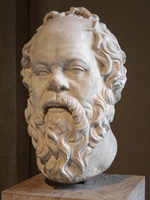
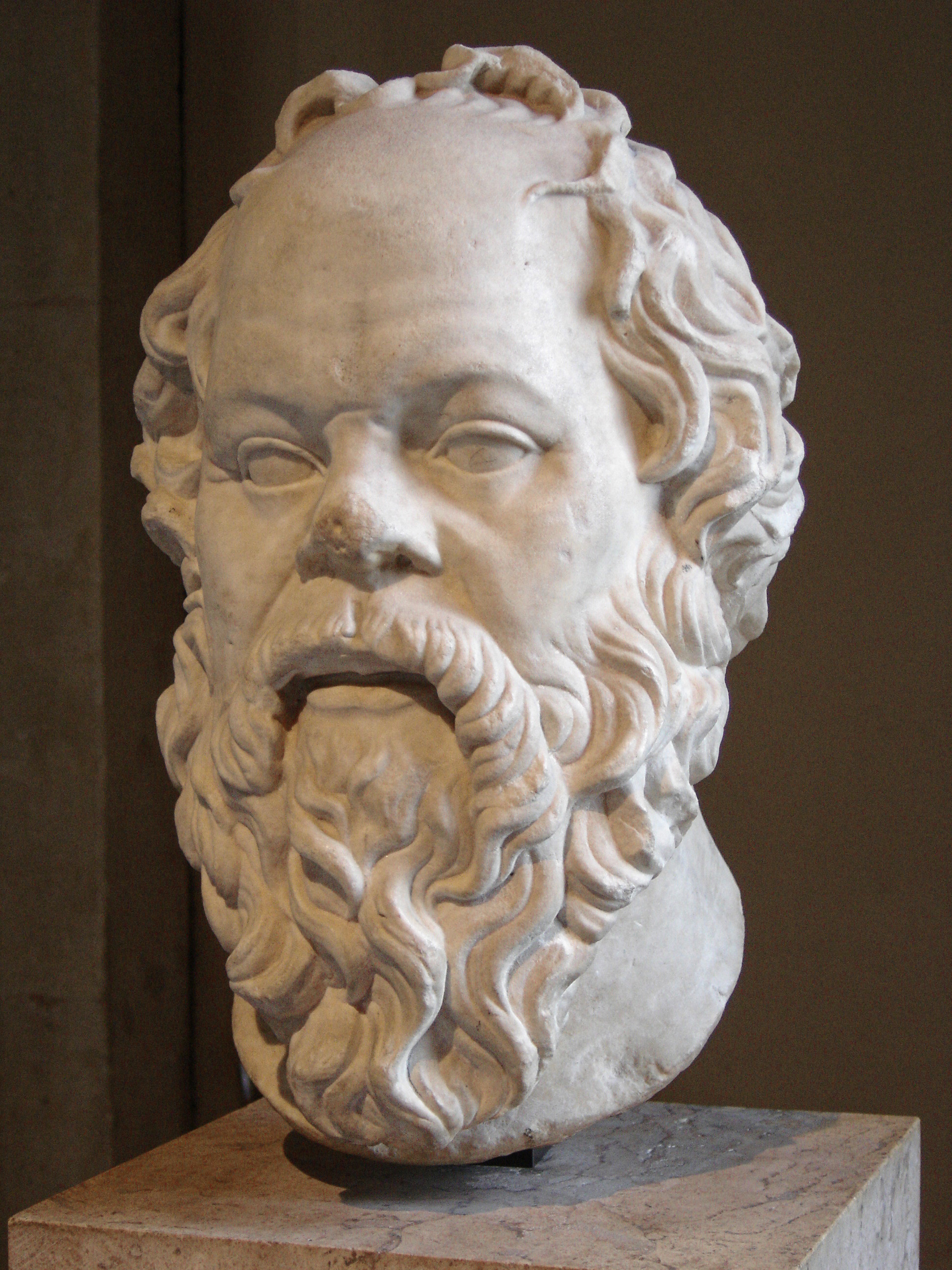
He was, by all accounts, spectacularly ugly: snub-nosed, bulging-eyed, pot-bellied, with a gait that his friends compared to a strutting waterbird. In a culture that prized physical beauty, this made him an odd figure – and Plato makes much of the contrast between Socrates' unlovely exterior and the beauty of his soul.
Socrates lived through the golden age of Athens and its collapse. He was in his twenties when the Parthenon was built and in his sixties when Athens surrendered to Sparta in 404 BCE. He knew the leading figures of his day, including the brilliant and unreliable Alcibiades, and he was the subject of a comedy by Aristophanes, The Clouds, which portrayed him as a crackpot scientist with his head in the air – a portrait Socrates himself later blamed for his bad reputation.
At some point, apparently in middle age, Socrates turned away from the natural science that fascinated his contemporaries and towards a single question: how should a human being live? He described his mission as a divine one. According to Plato, a friend once asked the oracle at Delphi whether anyone was wiser than Socrates, and the oracle answered no. Socrates, who was sure he knew nothing, set out to understand what this could mean – and concluded that his only wisdom lay in knowing that he did not know, whereas everyone else thought they knew things they did not.
The trial and death
In 399 BCE, five years after the fall of Athens and the brief, brutal rule of the pro-Spartan “Thirty Tyrants,” three citizens brought charges against Socrates: that he did not recognise the gods of the city, that he introduced new divinities, and that he corrupted the young. The real motives were probably political. Several of Socrates' former associates, including Alcibiades and Critias, the leader of the Thirty, had done Athens great harm, and the restored democracy was in no mood to be tolerant of the man who had taught them to question everything.
Socrates was tried before a jury of around 500 citizens. Plato’s Apology – the word means “defence,” not “expression of regret” – gives his speech. Instead of pleading or flattering, Socrates defended his whole way of life, told the jury that he would never stop philosophising even if they ordered him to, and declared that “the unexamined life is not worth living.” He was found guilty by a fairly narrow margin. When invited to propose his own penalty, he suggested, half-seriously, that Athens should reward him with free meals. The jury voted for death.
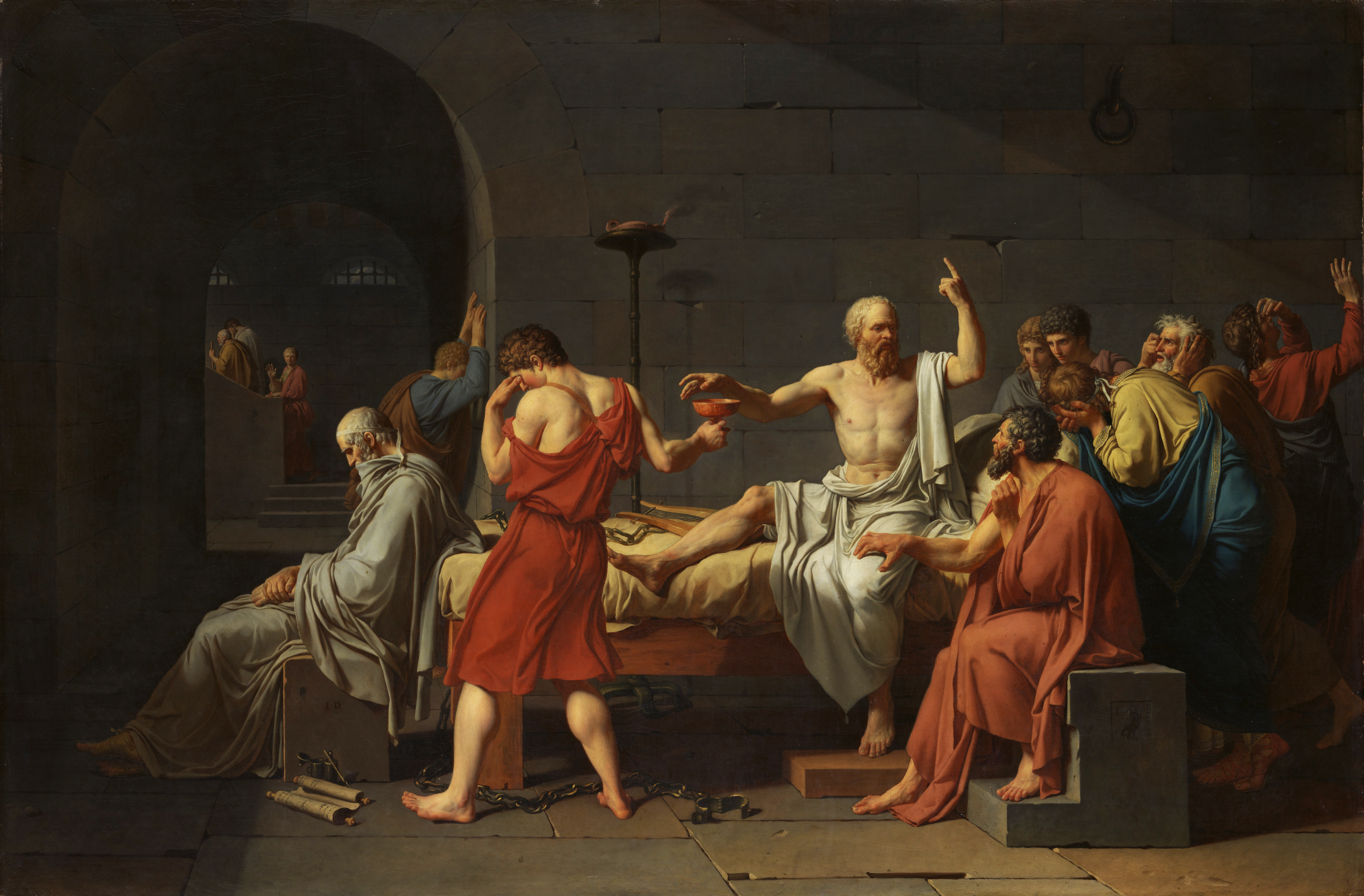
He could have escaped; his friends had arranged it. He refused, arguing in the Crito that he had lived his whole life under the laws of Athens and would not now break them to save his skin. A month later, surrounded by friends, he drank the hemlock, walked around until his legs grew heavy, lay down, and died. Plato’s account in the Phaedo is one of the most moving passages in all literature.
The sources: the “Socratic problem”
Since Socrates wrote nothing, everything we know about him comes from others – and they do not agree. The main sources are:
Plato – Socrates is the central character in almost all of Plato’s dialogues. But Plato was a philosopher of genius in his own right, and it is often impossible to tell where the historical Socrates ends and Plato’s own ideas begin. Most scholars think the early dialogues (Apology, Crito, Euthyphro, Laches, Charmides) are closest to the real man, while the Socrates of the Republic is largely Plato’s spokesman.
Xenophon – A soldier and historian who knew Socrates and wrote several works about him, including the Memorabilia and his own Apology. His Socrates is more down-to-earth, more conventional, and frankly less interesting than Plato’s – which may or may not mean he is more accurate.
Aristophanes – The Clouds (423 BCE) is a hostile caricature, but it is the only portrait written while Socrates was alive and in his prime.
Aristotle – Born fifteen years after Socrates' death, Aristotle never met him but offers a few valuable comments, notably that Socrates was interested in ethics rather than nature, and that he sought universal definitions.
The problem of reconstructing the real Socrates from these conflicting portraits is known as the Socratic problem. It has no definitive solution. What follows is the broadly agreed picture.
The big ideas
The Socratic method
Socrates' way of doing philosophy is his most important legacy. He did not lecture. He asked questions. Typically, he would ask someone who claimed expertise – a general on courage, a priest on piety, a rhetorician on justice – to define the thing they claimed to know about. He would then draw out the consequences of the definition and show, through further questions, that it led to contradictions or absurdities. His partner would try again, and fail again. The conversation would often end in aporia: a state of puzzlement in which everyone realises they do not know what they thought they knew.
This procedure is called the elenchus (refutation or cross-examination), and its point was not to humiliate. Socrates believed that false confidence is the greatest obstacle to wisdom, and that clearing it away is the necessary first step. He compared himself to his mother the midwife: he could not give birth to knowledge himself, but he could help others bring it into the world – or expose it as a false pregnancy.
Knowing that you do not know
Socrates' famous claim to ignorance is often misunderstood as false modesty. It was in fact a serious philosophical position. He held that on the questions that matter most – what justice is, what goodness is, how one should live – nobody had genuine knowledge, including himself. But he also held that there was a crucial difference between the person who knows this and the person who does not. Recognising one’s ignorance is the beginning of wisdom; failing to recognise it is the source of most human folly.
Care of the soul
Socrates' central conviction was that the most important thing about a person is the state of their soul – their character, their moral condition – and that most people spend their lives neglecting it while chasing money, reputation and pleasure. In the Apology he tells the Athenians that he has spent his life going around like a father or older brother, urging them to care for virtue. This is what he means by saying that the unexamined life is not worth living: a life in which one never stops to ask what one is doing, and why, and whether it is good, is not a fully human life.
Virtue is knowledge
Socrates appears to have held that virtue – being a good person – is a kind of knowledge, and that if people really understood what was good, they would do it. Nobody, he argued, does wrong willingly: wrongdoing is always the result of ignorance about what is truly good for oneself. This claim, known as Socratic intellectualism, strikes most people as obviously false; we all know we sometimes do things we know to be wrong. But Socrates' point was sharper than it appears. He thought that anyone who truly grasped that injustice damages the soul – the most precious thing they have – would no more choose it than they would choose to drink poison.
It is better to suffer wrong than to do it
Following from this, Socrates held that the only real harm that can befall a person is harm to their soul. Being robbed, exiled or even killed does not make you a worse person; committing injustice does. In the Gorgias, Plato has him argue that it is better to suffer injustice than to commit it – and in the Crito, that one must never return a wrong for a wrong. This was a radical break with Greek common sense, which took it for granted that you should help your friends and harm your enemies. It is also, arguably, the foundation of the whole Western tradition of ethics.
The daimonion
Socrates spoke of an inner voice, a daimonion or “divine sign,” which sometimes warned him against doing things but never told him what to do. He took it seriously and so did his accusers – this was probably what lay behind the charge of “introducing new divinities.” Whatever it was, it points to a side of Socrates that is easy to forget: he was not a modern secular rationalist but a deeply religious man who believed his mission had been given to him by the god.
Why Socrates matters
Socrates' death made him the first martyr of philosophy, and his life set the template for what a philosopher is supposed to be: someone who follows the argument wherever it leads, who values truth over comfort and safety, and who lives by their convictions rather than merely holding them.
Almost every school of ancient philosophy claimed him. Plato built his entire system around him. The Cynics took his indifference to wealth and convention and pushed it to extremes. The Stoics revered him as the model of the wise man who is happy even in a prison cell. The Sceptics claimed his professions of ignorance as their own. Even the Epicureans, who disliked him, had to define themselves against him.
In the modern era, Socrates has been a hero to thinkers as different as Montaigne, Kierkegaard, John Stuart Mill and Hannah Arendt. Mill wrote that it is “better to be Socrates dissatisfied than a fool satisfied.” Kierkegaard modelled his whole authorship on Socratic irony. Nietzsche, characteristically, both admired and detested him, seeing in Socrates the moment when Greek culture turned from instinct to reason. And Socrates has become a symbol of intellectual freedom – the man killed by a democracy for asking too many questions.
Relevance to life
More than any other ancient philosopher, Socrates offers not a doctrine but a practice – and it is a practice anyone can take up.
Examine your life. Socrates' basic demand is simply that we stop and ask what we are doing and why. Most of us run on autopilot, absorbing our values from our surroundings without ever inspecting them. The Socratic question – “But what do you actually mean by that, and do you really believe it?” – is a tool for waking up.
Admit what you do not know. The Socratic stance of acknowledged ignorance is the opposite of the confident opinion-having that social media rewards. Practising it – genuinely saying “I don’t know” and meaning it – is both humbling and liberating. It is also the precondition for learning anything.
Ask questions instead of making assertions. The Socratic method is a model for good conversation and good teaching. Rather than telling people they are wrong, ask them to explain what they think and follow the thread. It is more respectful, more effective, and you may find you were the one who was confused.
Care for what matters. Socrates' insistence that the state of your character matters more than your bank balance or your reputation is a standing challenge to how most of us actually allocate our time and attention.
Never do wrong in return. The principle that one should never retaliate with injustice, however badly one has been treated, is Socrates' most demanding legacy – and one that has echoed through Christianity, Gandhi and the civil rights movement.
Live your convictions. Socrates could have talked his way out of a death sentence. He did not, because doing so would have meant betraying everything he had said about how to live. Few of us will face such a choice, but the question of whether our lives match our stated beliefs is one he forces us to ask.
◊ ◊ ◊
Where to start reading
- Apology – Plato’s version of Socrates' defence speech. The essential text: short, dramatic and unforgettable.
- Crito – Socrates in prison, explaining why he will not escape. A brief masterpiece on law and conscience.
- Euthyphro – The Socratic method in action, on the question of what piety is. Contains the famous “Euthyphro dilemma” about the relationship between the gods and goodness.
- Phaedo – Socrates' last day and death. Longer and more Platonic in its philosophy, but the closing pages are unmissable.
- Xenophon, Memorabilia – for a very different, more homespun Socrates.
- Aristophanes, The Clouds – the comic caricature, for balance.
The five “trial and death” dialogues (Euthyphro, Apology, Crito, Phaedo, plus Meno) are conveniently collected in the Hackett volume Plato: Five Dialogues (translated by G.M.A. Grube, revised by John M. Cooper) and in the Penguin Classics The Last Days of Socrates.
Read more
- Socrates – Stanford Encyclopedia of Philosophy. Detailed and scholarly, with a good treatment of the Socratic problem.
- Socrates – Internet Encyclopedia of Philosophy. A more approachable overview.
- Plato’s Apology – The Internet Classics Archive (MIT). Free full text in Benjamin Jowett’s classic translation.
- Xenophon’s Memorabilia – Perseus Digital Library. Free full text with Greek original alongside.