Plato
The philosopher who taught the West how to ask questions
If Western philosophy had a founding father, it would be Plato. The British philosopher Alfred North Whitehead famously said that the whole European philosophical tradition “consists of a series of footnotes to Plato.” That is an exaggeration, but not by much. Almost every big question philosophers still argue about – What is knowledge? What is justice? Is the soul immortal? What is love? How should we live together? – was put on the table by Plato, and often in a form that has never been improved upon.

Who was Plato?
Plato (c. 428/427 – 348/347 BCE) was born in Athens into a wealthy and politically well-connected family. His father Ariston and mother Perictione belonged to the old Athenian aristocracy, and as a young man Plato would have been expected to go into politics. He never did – and the reason he gave was the fate of his teacher.
That teacher was Socrates, a man who wrote nothing, held no official position, and spent his days in the marketplace asking people awkward questions about what they thought they knew. In 399 BCE, the Athenian democracy put Socrates on trial for “corrupting the youth” and “not believing in the gods of the city,” and sentenced him to death. Plato was about twenty-eight. Watching the best man he knew being killed by his own city convinced him that something was deeply wrong – not only with Athens, but with the way people in general thought about justice, knowledge and the good.
After Socrates' death, Plato travelled, possibly to Egypt and certainly to southern Italy and Sicily, where he came into contact with the Pythagoreans, whose love of mathematics left a permanent mark on his thinking. He also made three visits to Syracuse, where he tried – and spectacularly failed – to turn the local tyrants Dionysius I and Dionysius II into philosophically enlightened rulers. On one occasion he was reportedly lucky to get away with his life.
Around 387 BCE, back in Athens, Plato founded a school in a grove just outside the city walls sacred to the hero Akademos. The Academy, as it came to be called, is often described as the first university in the Western world. It survived, in one form or another, for almost 900 years. Its most famous student was Aristotle, who studied there for nearly twenty years. Plato taught and wrote at the Academy until his death at around eighty.

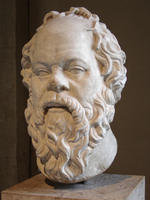
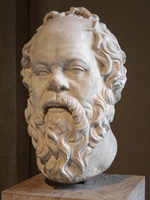
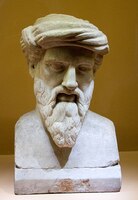
Plato, portrait bust. Image: Wikipedia.
The main works
Plato wrote dialogues: philosophical conversations, usually with Socrates as the main speaker, in which ideas are tested, attacked, defended and sometimes abandoned. He never speaks in his own voice, which makes reading him both delightful and frustrating – we are never quite sure which opinions are Plato’s own.
Scholars traditionally group the roughly two dozen genuine dialogues into three periods:
Early dialogues – These are closest to the historical Socrates. They usually pick one concept – courage (Laches), piety (Euthyphro), friendship (Lysis) – and show Socrates dismantling his conversation partner’s confident definitions without offering a final answer of his own. The Apology, Plato’s version of Socrates' speech at his trial, and the Crito, in which Socrates refuses to escape from prison, belong here too. They are the best place to start.
Middle dialogues – Here Plato’s own philosophy emerges. The Meno introduces the idea that learning is a kind of remembering. The Phaedo describes Socrates' last hours and argues for the immortality of the soul. The Symposium is a dinner party discussion about love. The Phaedrus deals with love, rhetoric and the soul. And the Republic, Plato’s masterpiece, weaves justice, politics, education, psychology, art and metaphysics into a single enormous argument about how to live.
Late dialogues – These are harder and more technical. The Parmenides and Sophist wrestle with logical problems in Plato’s own theory of Forms. The Theaetetus asks what knowledge is. The Timaeus offers a cosmology that fascinated readers for two thousand years. The Laws, his longest and last work, is a more sober, practical rethinking of the ideal state.
The big ideas
The Theory of Forms
Plato’s central and most controversial idea is that the world we see is not the most real world. Think of all the beautiful things you have encountered: faces, sunsets, melodies. They are all different, and none of them is perfectly beautiful; each fades or changes. Yet we recognise something in common, beauty itself. Plato argued that this common thing – the Form (or Idea) of Beauty – is not a mental construct but a genuine, eternal, unchanging reality, of which the beautiful things around us are imperfect copies. The same goes for Justice, Equality, Goodness, and even ordinary things like Circle or Tree.
The Allegory of the Cave in the Republic is Plato’s famous picture of this. Prisoners chained in a cave watch shadows on a wall and take them for reality. One escapes, climbs into the sunlight and sees real things for the first time. When he returns to tell the others, they laugh at him – or want to kill him. The allegory is about education, about the difference between opinion and knowledge, and, unmistakably, about Socrates.
Knowledge and recollection
If the Forms are not in this world, how do we know about them? Plato’s striking answer, in the Meno and Phaedo, is that our souls encountered them before birth, and that learning is really recollection. Whatever we make of that, Plato’s underlying point remains powerful: genuine knowledge cannot simply be poured into us from outside. It has to be drawn out, by questioning and by our own effort of understanding.
The soul and the good life
In the Republic, Plato divides the soul into three parts: reason, which seeks truth; spirit, which seeks honour and gets angry at injustice; and appetite, which wants food, drink, sex and money. A just person is one in whom reason rules, spirit supports it, and appetite is kept in its place. This is not about suppressing desire but about inner harmony – and Plato insists that such harmony is the only route to genuine happiness. The tyrant who can do whatever he wants is, for Plato, the unhappiest person alive, because he is a slave to his own cravings.
The ideal state
Plato’s political theory mirrors his psychology. A just city, like a just soul, has three classes: rulers (reason), soldiers (spirit) and producers (appetite). The rulers should be philosopher-kings, people who have been educated for decades to understand the Good and who, crucially, do not want power. Plato was deeply suspicious of democracy, which he had seen kill Socrates, and equally of tyranny. His proposals – including the abolition of private families among the ruling class and censorship of poetry – have shocked readers ever since. But the underlying question is still ours: who is fit to govern, and how do we produce such people?
Love and beauty
In the Symposium, the priestess Diotima describes love as a ladder: we begin by loving one beautiful body, then come to love beauty of character, then beauty of knowledge, until finally we glimpse Beauty itself. Love, for Plato, is the force that pulls us upwards from the physical towards the eternal. This is the origin of what we still call “Platonic love,” although Plato’s own version is far more passionate than the modern phrase suggests.
Why Plato matters
Plato’s influence is difficult to overstate. He shaped Aristotle, who spent much of his career arguing with him. He shaped Christianity: Augustine and many Church Fathers read the Forms as ideas in the mind of God, and the immortal soul yearning for a higher world became Christian doctrine. The Neoplatonists of late antiquity, Islamic philosophers like al-Farabi, Renaissance humanists, Romantic poets and modern mathematicians have all claimed him.
He also created his fiercest critics. Nietzsche accused him of inventing the “true world” behind appearances and thereby devaluing this life. Karl Popper, in The Open Society and Its Enemies, saw the Republic as a blueprint for totalitarianism. That thinkers of this stature still felt they had to fight him is itself a measure of his significance.
Above all, Plato gave us a method: the idea that we get closer to truth by dialogue, by putting our beliefs into words and letting others test them. Philosophy as a conversation, rather than a set of pronouncements, is Plato’s invention.

The Allegory of the Cave, engraving by Jan Saenredam after Cornelis van Haarlem (1604). Image: Wikipedia.
Relevance to life
It is easy to treat Plato as a museum piece. But a surprising amount of his thinking speaks directly to how we live now.
Opinion versus knowledge. We live in the cave more than ever: a world of screens, feeds and images that we mistake for reality. Plato’s insistence that most of what we confidently “know” is second-hand shadow-play is a useful daily discipline. Ask yourself, as Socrates would: how do I actually know this?
The ordered soul. Plato’s three-part psychology is a remarkably practical tool for self-understanding. When we feel torn – between what we know is good for us and what we crave, or between reason and wounded pride – we are living out the Republic’s inner drama. His claim that happiness lies in harmony among these parts, not in satisfying every appetite, anticipates a great deal of modern psychology.
The ladder of love. Plato’s account of love invites us to ask what we really love in the people and things we love. Is it only the surface? Or does the surface point to something deeper – kindness, courage, a way of seeing the world? Learning to love the deeper thing, Plato suggests, is what makes love grow rather than fade.
Who should have power? Plato’s worry that people who want power are usually the last who should have it, and that a society gets the leaders its education produces, is as pointed today as it was in Athens.
Philosophy as a way of life. Finally, Plato reminds us that philosophy is not primarily a body of doctrine but an activity: talking, questioning, refusing to settle for easy answers. You do not need to accept the Forms to practise this. You only need to be willing, like Socrates, to admit that you might be wrong – and to find that exciting rather than threatening.
◊ ◊ ◊
Where to start reading
- Apology – Socrates' defence speech. Short, moving, and the best introduction to what philosophy is for.
- Euthyphro and Crito – brief early dialogues on piety and on obeying the law.
- Meno – on whether virtue can be taught, and the idea of learning as recollection.
- Symposium – the dinner-party dialogue on love; also Plato at his most literary.
- Republic – the big one. Start with Books I–II and VI–VII (the Cave) if you find it daunting.
Good modern translations are available from Hackett (edited by John M. Cooper, Plato: Complete Works) and in the Penguin Classics and Oxford World’s Classics series.